Orly to Charles de Gaulle: Every Way to Cross Paris Between Flights (2026 Guide)

You have just arrived at Orly, and your connecting flight departs from Charles de Gaulle in four hours. The arrivals board gives no information on how to get there, since nothing simple connects the two airports. There is no direct train, and there has not been a direct bus for years. You're going to cover the whole of the Paris region, moving from the south to the northeast, and the method you choose will determine whether you spend that time relaxed or rush through Terminal 2E.
The distance from Orly to Charles de Gaulle is about 42 kilometres, and depending on the traffic conditions and the mode of transport you choose, the journey can take anywhere from 45 minutes to more than two hours. This guide is for anyone making that connection—whether you are travelling between airports on the same day, changing airports during your trip, or have only recently realised the two airports are at opposite ends of the city.
Booking a private transfer in advance removes the element of uncertainty, but it's important to understand all the options first—even those that will actually do quite well if you aren't in a rush.
Quick Answer: The Best Way from Orly to Charles de Gaulle
For most travellers, a private transfer (€€) is the best option because it provides door-to-door service, involves no transfers, and includes a driver who tracks your flight. The combination of the RER B and Orlyval or the Metro 14 (€) is the most economical choice and works satisfactorily if you're travelling with only a light luggage load and have some spare time. A taxi (€€) offers a middle ground: it doesn't require advance booking, but you'll have to wait in the rank and are subject to metered traffic.
| Distance | Fastest option | Cheapest option | Most comfortable |
|---|---|---|---|
| ~42 km | Private transfer / taxi (traffic-dependent) | RER B + Orlyval or Metro 14 | Private transfer |
Understanding the Orly → CDG Routee
Orly is located south of Paris, while Charles de Gaulle is situated northeast, beyond Saint-Denis and Le Bourget; it's impossible to regard this as a short journey since you're effectively having to drive or ride right through the capital or around it.
If taking the road, drivers usually go north on either the A6 or the A106 towards the Boulevard Périphérique or the A86 and then take the A1 or the A3 heading for Roissy. This route passes by Stade de France and goes through Saint-Denis, one of the most congested areas in the region during weekday rush hours. Indeed, there is no motorway on this route that completely avoids Paris, and that is one reason journey times vary so much.
There used to be a direct bus service between the two airports, but since Line 3 of Le Bus Direct was discontinued, there has been no direct bus. At present, all public transport options require at least one change, typically at Antony or Châtelet-Les Halles.
Your Transfer Options, One by One
The way each option works out on this particular route – not in general terms, but when going from Orly's terminals to CDG's – is as follows.
Private Transfer
Verdict: This is the nearest thing you can get to a guarantee when taking this route.
A private transfer that has been booked in advance will collect you directly at your Orly terminal—either Orly 4 (the former Orly Sud) or Orly 1-2-3 (the former Orly Ouest)—and take you to your designated CDG terminal, which may be Terminal 1, 2, or 3. You won't need to make transfers, walk across platforms, or figure out which RER B train continues past Antony.
The journey takes between 45 and 90 minutes, depending on traffic, and is charged ,per vehicle, not per person (€€), so this matters if you are travelling with a family or in a group. Whether or not you have luggage makes no difference since the driver will look after it and there is no need to walk between the platforms with a suitcase in each hand.
Pros:
- Fixed price agreed before you travel, not a meter running through traffic
- Driver tracks your flight and adjusts for early or delayed arrivals
- Works at any hour, including outside RER B and Orlyval operating times
Cons:
- Costs more than public transport if you're travelling solo
- Still subject to road traffic on the A1/A86 corridor, though the driver knows the alternative routes
RER B + Orlyval
Verdict: good choice if you have time and pack light.
Leave Orly and take the Orlyval – the automated shuttle – from either Orly 4 or Orly 1-2-3 to Antony station. The journey is short, and the shuttle runs every 5 to 7 minutes from 6 a.m. until 11:35 p.m. When you arrive in Antony, switch to the RER B bound for the north, as this line goes directly through central Paris (passing Denfert-Rochereau, Châtelet-Les Halles and Gare du Nord) before arriving at CDG. Decide in advance which CDG terminal you need – either Terminal 1 or Terminal 2 – before getting on the train, as having to get off at the wrong one would mean a confusing journey to reach the correct one.
The journey takes between 70 and 90 minutes from one station to another, but it takes longer if you are carrying luggage or have to wait. Tickets are priced at the lower end of the scale (in euros), and a combined ticket for the Paris Region and the airports includes the entire journey so that there is no need to purchase separate tickets at Antony.
Pros:
- Cheapest realistic option on this route
- No traffic risk once you're on the train
- Frequent departures — RER B every 10–20 minutes, Orlyval every 5–7
Cons:
- Requires a change with luggage at Antony, then navigating CDG's station layout
- Doesn't run overnight — no service before 6am or after roughly 11:30pm
- Standing room only during peak commuter hours, which makes suitcases awkward
You can check official train schedules and connections on the SNCF timetable page
RER B + Metro Line 14
The verdict is that it is a bit faster than the Orlyval route, provided that you are okay with going through Paris.
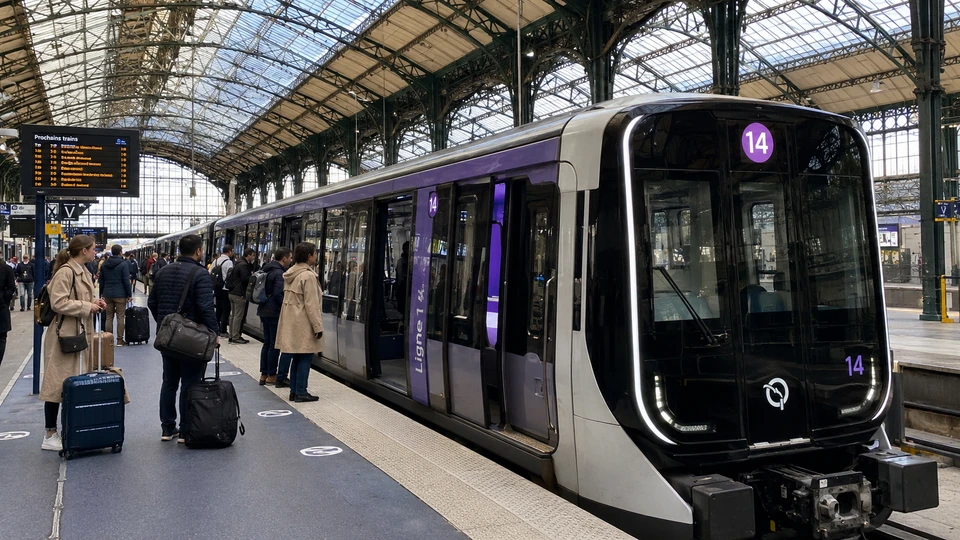
You might avoid using the Antony connection and instead go by Metro Line 14 from Orly all the way to Châtelet-Les Halles, after which you can transfer to the RER B heading towards CDG; Line 14 is fully automated and step-free, which is helpful when travelling with luggage, but the walk between the two lines at Châtelet is almost 500 metres—much longer than the 50-metre transfer at Antony.
The timing is much the same as the Orlyval route and can, in some cases, be slightly quicker because Line 14 trains are frequent and rarely late. The drawback, however, is having to go through one of Paris's busiest interchange stations while carrying bags.
Pros:
- Automated, step-free trains on the Metro 14 leg
- Comparable speed to the Orlyval route, occasionally quicker
Cons:
- Long underground walk at Châtelet with luggage
- Same lack of overnight service as the Orlyval option
Taxi
The verdict is that it's convenient when you're at the rank, but not so much when you're planning in advance.

Licensed taxis are available outside the terminals at Orly and can take you directly to CDG without booking in advance. This is an advantage of taking a taxi rather than the train—there is no walking and no need to change vehicles—but you have to wait in line at the taxi rank and pay a fare that increases depending on the traffic conditions on the A1 or the Périphérique.
The trip should take 45 to 90 minutes, depending on the time of day, and the fare is charged per vehicle (€€), comparable to a private transfer but without knowing the price until you get there.
Pros:
- No advance booking required
- Direct terminal-to-terminal, same as a private transfer
Cons:
- Metered fare means Périphérique traffic costs you money, not just time
- Rank queues at Orly can run long around midday and early evening peaks
Ride-Hailing Apps
Verdict: it's suitable enough for use as a backup but is inconsistent when regarded as a plan.

Ride-hailing is available at both airports, but the pickup points are a walk from the arrival halls, and the prices go up during the peak travel times — precisely when you'll most need it. It works like a taxi in terms of transit time but doesn't guarantee a vehicle is waiting.
Pros:
- Can be cheaper than a taxi off-peak
- App-based tracking of your driver
Cons:
- Surge pricing during rush hour or bad weather
- Designated pickup zones at CDG and Orly add walking time versus a rank
Side-by-Side Comparison
| Option | Door-to-door time | Price level | Luggage | Transfers needed | Best for |
|---|---|---|---|---|---|
| Private transfer | 45–90 min | €€ | Handled for you | None | Families, tight connections, heavy luggage |
| RER B + Orlyval | 70–90 min | € | Manageable, one change | 1 (Antony) | Solo travellers, budget trips |
| RER B + Metro 14 | 70–90 min | € | Long walk at Châtelet | 1 (Châtelet) | Light packers comfortable with Paris transit |
| Taxi | 45–90 min | €€ | Handled for you | None | Last-minute, no advance planning |
| Ride-hailing | 45–100 min | €€ | Handled for you | None | Backup option, off-peak trips |
Which of the options is right for you?
For families who have young children: with a private transfer you won't have to change platforms when travelling with a stroller and two suitcases, and you can ask for a child seat in advance instead of hoping that the taxi has one.
For solo budget travellers the combination of the RER B and Orlyval is truly acceptable since you only have one bag, aren't bringing a toddler, and the cost is only a small portion of that of a car transfer.
When travelling in groups of four or more, splitting four RER tickets results in a quick reduction of the per-person savings; a private transfer that is charged per vehicle is usually cheaper on a per-head basis and involves a lot less trouble when you have four sets of luggage.
Travellers with tight connections: If your layover window is under three hours, don't risk a train change at Antony or Châtelet. A private transfer with flight tracking absorbs delays instead of adding to them.
For arrivals after late night or early morning: the RER B and the Orlyval cease running about 11:35 pm and do not begin again until around 5 to 6 am; outside of those times, your only options are a taxi, a private transfer or nothing.
First-timers in Paris: Navigating Antony or Châtelet mid-journey, in an unfamiliar transit system, with luggage, is a lot to ask on your first day. A transfer removes that entirely.
The Case for Booking a Private Transfer with Top Paris Transfer
When you are travelling with one or more bags, one or more people, or when the time between flights is less than three hours, both the calculations and the stress lead in the same direction.
For a group of four, the total cost of four individual RER tickets together with the Orlyval add-on can add up rapidly – and a €€ private transfer, which is charged per vehicle rather than per person, usually ends up being the cheaper option when you take everyone's fares into account. You also eliminate the risk altogether: there is no possibility of missing your connection at Antony and no chance of getting on the wrong platform at the confusing stations that differ between CDG's Terminal 1 and Terminal 2.
Top Paris Transfer monitors your incoming flight, so if you arrive late at Orly, your driver will still be waiting for you at your terminal with a name board, rather than being tied to a schedule that assumes on-time arrival. The prices are set before you travel and remain the same no matter how the A1 operates that afternoon. Child seats, additional luggage space, and 24/7 availability are included as standard features, since the RER B does not operate all night.
A realistic situation would be a family of four arriving at Orly 4 at midday and then connecting to a flight to CDG three hours later. With immigration, baggage claim and the walk to Orlyval taking up an hour, that hour is now gone. A private transfer picks them up at the terminal, and even though there is A1 traffic near Le Bourget, they still manage to check in at CDG with some buffer time left—something that would have been much more difficult if they had had to change trains at Antony using two suitcases and a car seat.
👉 Book a private transfer from Orly to Charles de Gaulle with Top Paris Transfer — at a fixed price and with the driver waiting for you at your Orly terminal.
When to Travel: Traffic & Timing on This Route
From morning until 9.30 a.m. the Périphérique and the A1 have a heavy volume of commuter traffic heading into Paris and towards Roissy; by road the journey should take about the upper end of the 90-minute range.
Midday: This is the most peaceful time for driving this route — usually the nearest you'll come to the 45-minute best-case scenario.
In the evening (from 4.30 to 7.30 p.m.): Traffic increases once more, especially on the A1 road as it approaches CDG and as it passes through Saint-Denis. Public transport becomes more competitive at this time since it is not affected by road congestion.
At late hour the RER B and the Orlyval cease operations at 11:35 p.m., so that taxis and private transfers are the only practical alternatives.
It is worth mentioning one seasonal aspect: during weeks when trade fairs are taking place at the Parc des Expositions in Villepinte, near CDG, there is a noticeable increase in traffic on the A1 approach—so if your dates coincide with a large exhibition it's advisable to allow extra time.
What This Route Really Costs (Including the Costs Nobody Mentions)
Public transport is clearly in the € category since one combined ticket will cover the entire journey whether it's Orlyval plus RER-B or Metro-14 plus RER-B without the need to buy additional tickets at some point along the way. Taxis and private transfers are in the €€ range and are priced per vehicle rather than per passenger, so the cost calculation changes if more than one person is travelling.
There are some costs to be aware of: if you do not purchase the combined fare, you have to buy a separate ticket for the Orlyval shuttle, so people who think their RER ticket includes it can be disadvantaged at the barrier. Furthermore, taxis impose a toll surcharge when the route involves the A1, and the fare increases with the time spent stuck in traffic—a feature a private transfer's fixed price completely avoids.
For a group of two or more people who have luggage, the actual cost usually makes private transfers the better choice when you take into account the trouble of buying the tickets, the walking between platforms, and the risk of a delay causing you to miss your connection.
Mistakes to Avoid on the Orly → CDG Journey
Assuming there's a direct train or bus. There isn't — not since Le Bus Direct's Line 3 was discontinued. Every option involves at least one change.
Missing the correct CDG station. There are two RER B stations at CDG, one roughly corresponding to Terminal 1 and the other to Terminal 2. Make sure the one you choose matches the terminal you are arriving at before you board, as it will take a lot of time to correct your stop later.
Buying separate Orlyval and RER tickets. The combined Paris Region–Airports ticket covers the full journey and works out cheaper than buying each leg individually.
Planning a train connection for a late-night or pre-dawn flight, please note that the RER B and Orlyval services do not operate between about 11:35 pm and between 5 and 6 am — so before deciding on a taxi or transfer, you should check your flight time against those hours.taxi or transfer.
The Châtelet walk should be allowed for in your timetable. When taking Metro 14 rather than the Orlyval, plan extra time for the transfer corridor, which is almost 500 metres long, particularly if you are travelling with a suitcase.
If you cut the connection too closely during the trade fair season, the A1 approach can suffer real delays—make sure to check the calendar to see whether your dates overlap.
FAQ
Excuse me, is there a direct train running between Orly and Charles de Gaulle?
On the contrary, you'll have to make at least one change, either by going from Antony to Orlyval or by taking the Châtelet-Les Halles route and then transferring to Metro Line 14. Both options connect with the RER B for the journey to CDG.
How long does the journey take from Orly to CDG?
By road, it takes between 45 and 90 minutes, depending on traffic conditions. If you take the RER B and Orlyval or Metro 14, allow 70 to 90 minutes for the journey between stations, plus extra time for the change.
Is there any direct bus service running between Orly and CDG?
It's no longer the case. Line 3 of Le Bus Direct, which previously operated between the two airports, has been cancelled.
What terminal at CDG does the RER B serve?
At CDG, there are two RER B stations: one at Terminal 1 and the other at Terminal 2. Check in advance which terminal you need, as the two stations are not easily accessible on foot.
Should one pay for a private transfer when arriving on the same day?
For most travellers with a layover under three hours, yes — it removes the risk of a missed train change or a wrong-platform mistake costing you the connection.
Do RER B and Orlyval run all night?
No. Both stop around 11:35pm and resume roughly 5–6am, so overnight connections need a taxi or private transfer.
Can I use a Navigo pass for this journey?
The Navigo pass covers RER B, but not the Orlyval shuttle, which requires its own ticket unless you buy the combined Paris Region–Airports fare.