Getting from Charles de Gaulle to Montmartre: Every Transfer Option Compared (2026 Guide)

When you arrive at CDG, go through passport control and immediately face your first real choice: how are you going to get from Charles de Gaulle to Montmartre and will it cost you money during your first evening in Paris? The airport is about 30km to the north-east of the city, while Montmartre is located on a hill in the far north of Paris, which seems convenient until you realise that being north of Paris doesn't mean it's easy to reach. This guide is aimed at anyone landing at CDG—whether they are travelling alone, have children with them, or are carrying a suitcase that won't fit down the stairs to Montmartre—who wants a clear answer before they have even collected their luggage. Although a pre-booked private transfer eliminates most of the uncertainty in this situation, it's worthwhile looking into the reasons behind this before deciding to go with it.
Quick Answer: The Best Way from Charles de Gaulle to Montmartre
For the majority of travellers, taking a private transfer or using the official flat-rates taxis is the simplest means of getting from CDG to Montmartre since the journey is door to door and is completed in less than an hour without having to change transport or drag their bags along the cobbled streets. Travellers on a budget can manage by taking the RER B to Gare du Nord and then making a short journey by metro. While public transport does work, it's not direct.
| Distance | Fastest option | Cheapest option | Most comfortable |
|---|---|---|---|
| ~30km / 18 miles | Private transfer or taxi | RER B + metro | Private transfer |
Understanding the Charles de Gaulle → Montmartre Route
Montmartre is located in the 18th arrondissement, on the Right Bank of Paris, and lies approximately north-west of CDG when measured in a straight line. If travelling by road, drivers take the A1 motorway south from the airport, passing through the industrial areas of the northern suburbs until they reach Porte de la Chapelle, one of the principal entrances to the city.
From that point on, the route is a bit more complicated than most guides admit. A driver has the choice of staying on the Boulevard Périphérique for approximately 800 metres and then taking the exit at Porte de Clignancourt — this is the neater way into the 18th arrondissement — or of going directly through Rue Marx Dormoy, which is faster in theory but notoriously congested during peak hours. Drivers who frequently take this route tend to prefer the detour via the Périphérique exactly because it avoids that traffic bottleneck.
You can't take a direct train to Montmartre. Although the RER B goes directly from the airport to Gare du Nord and Châtelet-Les Halles, Montmartre does not have its own RER station—you'll have to make a short metro transfer (typically taking line 2 to Anvers or line 12 to Abbesses) to complete your journey. Establish that fact at the beginning, so that public transport doesn't seem like a trap.
Your Transfer Options, One by One
Here the compromise between price and comfort is as usual, the issue being how much of that compromise you are willing to handle by yourself with your luggage.
RER B Train + Metro Connection
Final assessment: It's cheap and immune to traffic, but it has two legs, not one.
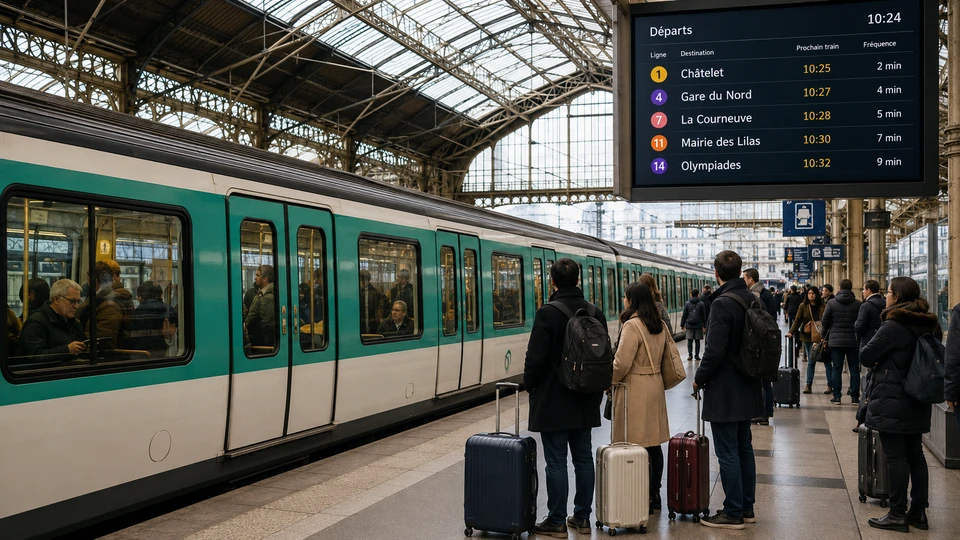
The RER B leaves either the Aéroport Charles de Gaulle 2 TGV (Terminal 2) or Aéroport Charles de Gaulle 1 (Terminals 1 and 3, accessible by the free CDGVAL shuttle) about every 10 to 15 minutes. It takes approximately 30 to 35 minutes to get to Gare du Nord, as it runs on its own tracks and is therefore mostly unaffected by road traffic. From Gare du Nord, you will have to take metro line 2 heading towards Anvers or make a short walk or connection towards Abbesses in order to reach the base of the Butte.
- Price level: € (per person)
- Luggage: manageable with a single case; genuinely unpleasant with two large suitcases and stairs at the connection
- Pros: immune to road traffic, frequent departures, direct to Gare du Nord
- Cons: requires a second leg to reach Montmartre; stations involve stairs; not ideal late at night with young kids
You can check official train schedules and connections on the SNCF timetable page
Bus 350 to Porte de la Chapelle
Final assessment: It's only worth it if the hotel you're staying at is actually among the best ones.
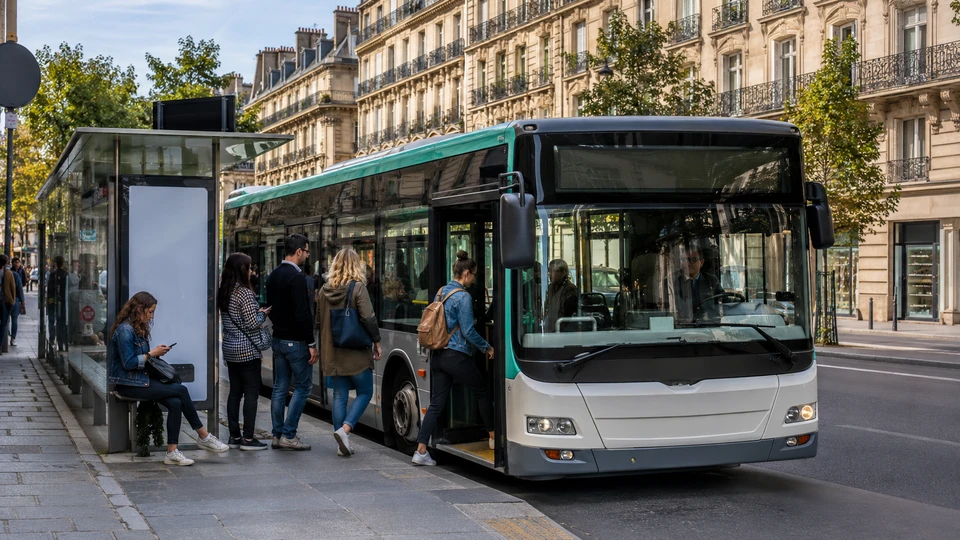
The 350 bus goes from CDG to Porte de la Chapelle, a point that is right on the northern border of the 18th arrondissement—closer in theory to Montmartre than to Gare du Nord—even though the bus is slower and less frequent than the RER.
- Price level: € (per person)
- Luggage: fine for light packers; tight if the bus is busy
- Pros: drops you closer to Montmartre's northern streets than the train does
- Cons: journey time varies a lot with traffic; service isn't as frequent as the RER B
Official Airport Taxi
Honest verdict: You can do it, but you'll have to wait in line when it's busy.

Official taxis are waiting outside all of the terminals at CDG. Since Montmartre is located on the Right Bank, it is entitled to the cheaper of the two flat-rate zones established by the Paris prefecture — this results in a small but genuine saving compared to places south of the Seine. The fare is based on the vehicle rather than on the number of passengers, which becomes important when there are more than one person travelling.
- Price level: €€ (per vehicle, up to four passengers)
- Luggage: full boot space, no issue
- Pros: fixed price agreed before you even sit down, one vehicle covers a group of four
- Cons: queues build fast during peak arrival banks; drivers can't get closer than Boulevard Barbès or Boulevard Rochechouart before the pedestrianised streets take over
Ride-Hailing Apps (Uber, Bolt)
Honest opinion: It's suitable to use as a backup but just as unpredictable when acting as a plan.

The pickup points for ride-hailing services at CDG are located a short walk from the arrival terminals and their prices vary in accordance with demand rather than remaining fixed; they can be lower than the taxi's flat rate during off-peak times or go well above it during a surge.
- Price level: € to €€€ (varies with demand)
- Luggage: same as taxi, space for a full boot
- Pros: can be cheaper than the taxi flat fare in quiet periods
- Cons: price isn't locked in advance; pickup point can be a hike with bags; no guaranteed driver at arrivals
Private Transfer with Top Paris Transfer
Final assessment: The one involving the taxi experience with no element left to chance.
A private transfer that has been booked in advance takes the same route from A1 to the Périphérique as a taxi, the driver being already waiting inside the terminal, keeping track of your flight, and the price having been set at the time you booked rather than having to queue, or face a surge in fares, or decide which flat-fare zone applies.
- Price level: €€ (per vehicle, fixed regardless of traffic or time of day)
- Luggage: dedicated space, driver assists loading
- Pros: meet-and-greet inside arrivals, fixed price agreed in advance, driver knows to drop near Barbès/Rochechouart for the short walk up
- Cons: costs more than the RER B for a solo traveller with one bag
Side-by-Side Comparison
| Option | Door-to-door time | Price level | Luggage | Transfers needed | Best for |
|---|---|---|---|---|---|
| RER B + metro | 45–60 min | € | Manageable, stairs involved | 1 (metro connection) | Solo, light packers, budget-conscious |
| Bus 350 | 50–70 min | € | Manageable | 0–1 | Very tight budgets, flexible timing |
| Official taxi | 30–45 min | €€ | Full boot | 0 | Small groups wanting fixed price |
| Ride-hailing | 30–50 min | €–€€€ | Full boot | 0 | Backup option, off-peak trips |
| Private transfer | 30–45 min | €€ | Full boot, assisted | 0 | Families, groups, late/early flights |
Which of the options is right for you?
For families with young children: the stairs at the Anvers or Abbesses metro, together with a stroller and two suitcases, are precisely the sort of situation that spoils the first afternoon; arranging a private transfer with an appropriate child seat avoids all that.
For single travellers travelling on a tight budget with just one bag the RER B is actually adequate; it takes thirty-five minutes to get to Gare du Nord with only one change of metro, so there's no need to spend too much money on a solo journey.
If you take four taxis or go for a private transfer, you'll usually find that the cost per person is cheaper than paying for four separate RER tickets — plus you get door-to-door service rather than having to change trains with your bags.
For people having a lot of luggage: the steepest roads in Montmartre are not suitable for wheeled suitcases; it's better to use a vehicle to get to Barbès or Rochechouart and then complete the journey by a short walk or by taking the funicular.
For arrivals in the late night or early morning: the RER B service does not operate all night, and although the queues of taxis get thinner they never completely disappear — if a transfer is pre-booked then someone will still be there no matter what the time.
For those visiting Paris for the first time, it is a common surprise to find that they don't know which metro exit leads to various destinations, or that there is no direct train at all to Montmartre; a direct transfer gets rid of that learning curve.
The Case for Booking a Private Transfer with Top Paris Transfer
When four people in a family or group arrive at CDG, the figures usually indicate that it is better to hire a private transfer than to purchase four separate train tickets — a fixed charge of €€ per vehicle ends up beating the cost of four individual € RER fares when the total is worked out, and that is before one even considers the connection with the metro while carrying the bags.
Your driver will keep an eye on your flight, so a delay does not mean that the pickup will be missed—they'll be waiting in the arrivals hall at the terminal and hall where your flight lands, having a sign ready. The price is settled before you land, something that is important on a route where the official taxi rank could result in a long wait during peak arrival hours. For travellers who don't want to have to think about transport twice during their trip, the availability of child seats, ample luggage space, and service at any time of day make a strong case.
A few weeks ago, when a family of four who had come in on a late evening flight from London realised that their connection would be landing after 10.00 p.m. with two young children and a folded stroller, they decided to change their planned journey from the RER B line to a transfer, the driver having still been waiting one hour past the original landing time without any extra charge and with no need to rush and get a taxi at Terminal 2E.
👉 Book a private transfer from Charles de Gaulle Airport to Montmartre with Top Paris Transfer — the price is fixed and the driver will be waiting for you when you arrive.
When to Travel: Traffic & Timing on This Route
The A1 road is least crowded outside the usual commuting times. During the morning peak, between 07:00 and 09:00, and in the evening peak, between 17:00 and 19:00, the Porte de la Chapelle junction becomes particularly congested — a trip which takes half an hour outside of peak hours can be considerably longer during those times. Travel at midday and in the late evening, on the other hand, is generally the smoothest.
You should watch out during the season for the large trade fairs held at Paris Villepinte, near the northern approach to the airport, since they cause noticeable congestion on the A1 during the weeks when the fairs are being set up and taken down; furthermore, on Bastille Day and during the period leading up to Christmas the traffic into the 18th increases as tourist groups head for Sacré-Cœur.
What This Route Really Costs (Including the Costs Nobody Mentions)
Since the RER B is charged on a per-person basis, it becomes very expensive when travelling in groups—four separate € tickets can easily total more than the price of a single €€ vehicle once all the people have been taken into account. Similarly, both the official taxi and the private transfer are priced per car, which is when the real value becomes evident for two or more travellers.
There are some costs you should be aware of: the RER B ticket is a special fare for the airport, not a standard metro ticket, so it's not true that a normal Navigo pass will cover it. Both taxis and transfer services include luggage and up to four passengers in the fixed price—there is no extra charge per bag. The only thing that isn't covered anywhere is the walk from Barbès or Rochechouart up into the pedestrianised area of Montmartre; you should allow a few extra minutes for the journey on foot or take the funicular if your hotel is close to the top of the Butte.
For an average family of four, the cost of a fixed private transfer proves cheaper than that of four RER tickets when you take into account the time saved and the stairs avoided.
Mistakes to Avoid on the Charles de Gaulle → Montmartre Journey
- If there is a direct train going to Montmartre. There isn't – the RER B stops at Gare du Nord and Châtelet and you will always have to change by metro there.
- When booking a hotel "in Montmartre" it is necessary not to check the street. There are some addresses advertised as being in Montmartre which are in fact situated well below the Butte, near flat streets that are much easier for a vehicle to access directly.
- We expected either a taxi or a driver to pull up at the front steps of Sacré-Cœur. Most of the upper Butte is designated as a pedestrian area and consists of cobbled streets; vehicles stop near Boulevard Barbès or Rochechouart, after which one has to take a short walk or ride the funicular to reach the destination.
- Not verifying which alternative to the Roissybus applies. The previous Roissybus service was discontinued in March 2026, and some travellers using out-of-date directions still try to find a stop that no longer exists.
- Taking large suitcases up the steepest roads in Montmartre. The slope and the cobbles are hard on the wheels and harder on the back; in that case, it is better to use the funicular or to go straight down.
- When I arrived at CDG during the week that the Villepinte trade fair was taking place, I had not booked in advance. Traffic on the A1 approach tends to become heavily congested during the periods when major exhibitions are being set up.
- We arrive late and therefore assume that the RER B is still running; in fact, night arrivals must use a taxi, a pre-booked transfer, or the Noctilien night bus since the RER B does not operate 24 hours a day.
FAQ
Is there a direct train from Charles de Gaulle to Montmartre?
On the contrary, the RER B goes directly to Gare du Nord and Châtelet-Les Halles, but there is no RER station in Montmartre — in that case you'll have to take a short metro connection, usually on line 2 to Anvers, to complete your journey.
What is the fare for a taxi from CDG to Montmartre?
In the case of official taxis the total fare for the whole vehicle is fixed rather than being charged on a per-person basis since Montmartre is in the lower of the two Paris zones with a flat fare (the Right Bank); the fare is set at the €€ level and not charged by a meter, so it is agreed upon before you start your journey.
How long does the journey take from CDG to Montmartre?
If you are travelling by road, plan for about 30 to 45 minutes outside of peak times, but it will take longer during the morning and evening commutes around Porte de la Chapelle. If you use the RER B and then the metro, allow approximately 45 to 60 minutes for the entire journey.
Can a taxi or transfer drop me off directly at Sacré-Cœur?
By no means. Most of the upper Montmartre is lined with footpaths and has cobblestones, so cars stop off at either the Boulevard Barbès or the Boulevard Rochechouart, after which one has to take a short walk or a ride on the funicular to get to the Basilica.
What took the place of the Roissybus when getting to this area?
Roissybus was permanently discontinued on 1 March 2026. Travellers now use the RER B from central stations or the newer Express 9517 service from the Saint-Denis Pleyel hub.
Is a private transfer worth it for a solo traveller?
Honestly, not always — if you're travelling light with one bag, the RER B is a perfectly reasonable way to save money. A private transfer makes more sense for groups, families, or late-night arrivals.
Which CDG terminal will I land at, and does it matter for pickup?
CDG has three terminals—the circular Terminal 1, the larger Terminal 2 with halls 2A–2G, and budget-focused Terminal 3 —linked by the free CDGVAL shuttle. A pre-booked driver will already know your terminal and hall from your flight number, so it only matters for self-navigated options like the RER B, where Terminal 2 and Terminals 1/3 use different stations.
Other Popular Blog You Might Need
- Best Ways to Get from Charles de Gaulle Airport to Campanile Val de France: Every Transfer Option Compared (2026 Guide)
- Charles de Gaulle Airport to Orly Airport: Every Transfer Option Compared (2026 Guide)
- Charles de Gaulle to Santa Fe Hotel: Every Transfer Option Compared (2026 Guide)
- Charles de Gaulle Airport to Val d'Europe: Every Transfer Option Compared (2026 Guide)