Charles de Gaulle Airport to Orly Airport: Every Transfer Option Compared (2026 Guide)

You have just arrived at Charles de Gaulle Airport; your connecting flight departs from Orly in four hours, and someone in the arrivals area says there is no direct train linking the two airports. That is correct and often surprises travelers. The two airports are located on opposite sides of Paris—CDG in the northeast and Orly to the south—with the distance between them being about 35 to 40 km, depending on the terminals you're using. When you take into account the journey from one door to another, the time costs between 45 minutes and just over an hour and a half, depending on traffic and the mode of transport you choose. This guide is for people who need to connect between the two airports: transit passengers, families with limited time, and business travelers who can't afford to miss their flight. If you prefer to avoid having to make any decisions, a privately booked transfer eliminates most of the uncertainty—but let's first go over the actual options available.
Quick Answer: The Best Way from Charles de Gaulle Airport to Orly Airport
The quickest and most comfortable way to travel from CDG to Orly is a private transfer or taxi via the A1 and A6, taking about 45 to 75 minutes depending on traffic (€€€, with fares charged per vehicle). The cheapest option is to use the RER B together with either Metro Line 14 or the Orlyval shuttle at Antony, since it is much less expensive per person (€), but it takes more than an hour and requires at least one change when carrying your luggage.
| Distance | Fastest option | Cheapest option | Most comfortable |
|---|---|---|---|
| ~35–40 km | Private transfer / taxi (off-peak) | RER B + Orlyval or Metro 14 | Private transfer |
Understanding the CDG → Orly Routee
CDG is located northeast of central Paris, while Orly is south, closer to the city but still part of its own distinct airport system. No route avoids going through central Paris, whether you use road or rail transport.
By road, drivers generally take the A1 south from Roissy and then either cut through the city via the Boulevard Périphérique or take a roundabout route via the A86 or the A106 before joining the N7 to reach Orly. The section of the Périphérique near Porte de Bercy and Porte d'Italie is the main bottleneck on the route, becoming heavily congested between 8:00 and 10:00 AM and again between 5:00 and 7:00 PM.
There is no direct rail service. Although the RER B runs the entire route, from the CDG stations all the way through Gare du Nord and Châtelet–Les Halles down to Denfert-Rochereau and on to Antony, you still have to change trains in order to get to Orly's terminals.
Your Transfer Options, One by One
Comfort and price go in opposite directions, since the more affordable choices require more from you and your suitcases.
Private Transfer
It can be done in less than an hour provided that the traffic is cooperative and somebody else takes on the worry.
The driver, booked in advance, will meet you at your CDG terminal, check your flight in case it is delayed, and take you straight to your Orly terminal—no changes and no need to decipher station signs. The fare is charged per vehicle, not per person (€€€), which makes a big difference for groups. The journey takes about 45 to 75 minutes, depending on the time of day.
Pros:
- Door-to-door with no transfers
- Fixed price agreed before you travel
- Fits families, groups, and awkward luggage without a second thought
Cons:
- Costs more than public transport for a solo traveler
- Still subject to the same traffic as any car
- Needs to be booked ahead rather than grabbed on arrival
Taxi
Even if it's quick and easy, the meter isn't concerned that you're in a hurry.

At the arrivals halls of both airports, official taxis are waiting in queues. Unlike a taxi journey from CDG to central Paris or from Orly to central Paris, there is no fixed zone fare for a trip between airports; this journey is metered, so the final charge will vary depending on traffic (€€ to €€€ per car). You can expect to pay something similar to that of a private transfer, and possibly more if you encounter the Périphérique at the wrong time.
Pros:
- Available without booking ahead
- Direct route, no changes
- One fare covers the whole car, not each passenger
Cons:
- No fixed price — the meter runs on traffic time, not distance
- Queues at the taxi rank can add 15–20 minutes at peak periods
- Fare uncertainty makes budgeting harder than a pre-agreed rate
RER B + Orlyval
Inexpensive, dependable, and actually good if you're traveling lightly.
Leave the RER B at CDG and take it towards Paris, passing through Gare du Nord and Châtelet–Les Halles until you reach Antony station, the official transfer point for Orly. At Antony, take the signs indicating Orlyval, an automated shuttle that provides the last leg of the journey to Orly's terminals. Note that even if you already have an RER ticket, you need to buy a separate Orlyval ticket; the machines are located next to the platform. The total travel time is about an hour, although it can be a bit longer when making the change.
Pros:
- By far the cheapest way to cover the route (€)
- Trains run frequently, roughly 5 AM to midnight
- No traffic to worry about — the schedule holds regardless of road conditions
Cons:
- At least one change, sometimes two, with your bags
- Standing room only during peak commuter hours
- Antony's signage trips up first-time visitors more than it should
You can check official train schedules and connections on the SNCF timetable page
RER B + Metro Line 14
The other interchange, and in fact it’s about even with Orlyval for the majority of people.
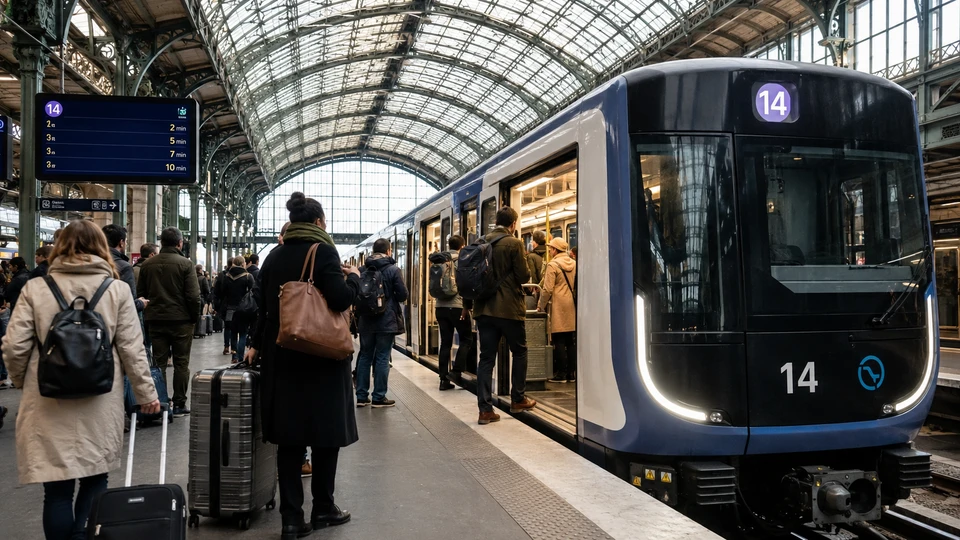
Instead of getting off at Antony, ride RER B all the way to Châtelet–Les Halles, then switch to Metro Line 14 heading toward Aéroport d'Orly — the line's southern terminus. Slightly faster on paper than the Orlyval route for some travelers, still around an hour total, and the ticketing is simpler since a single Paris Region–Airports ticket now covers the full CDG-to-Orly journey across RER B and Metro 14 without needing to buy anything extra en route, provided you don't exit the barriers.
Pros:
- Single ticket covers the whole trip if you don't exit stations
- Metro 14 platforms are generally easier to navigate with a case than Antony's
- Frequent service, minimal waiting between trains
Cons:
- Longer walk at Châtelet–Les Halles, one of the busiest interchange stations in Paris
- Still involves lugging bags through two separate systems
- Rush-hour crowding on Line 14 into central Paris
Shared Shuttle
It's less expensive than owning a private car, but you have to stick to other people's schedules.

A few shared shuttle services handle the route from CDG to Orly, usually picking up other passengers along the way. Their prices fall somewhere between public transportation and a private transfer (€€), but because of the number of stops, the journey time cannot be predicted—which isn't ideal when you're racing a connection.
Pros:
- Cheaper than a dedicated private transfer
- Door-to-door, unlike the train options
- No need to navigate stations with luggage
Cons:
- Other passengers' stops add time you can't control
- Less suited to tight connection windows
- Vehicle size and comfort vary by provider
Side-by-Side Comparison
| Option | Door-to-door time | Price level | Luggage | Transfers needed | Best for |
|---|---|---|---|---|---|
| Private transfer | 45–75 min | €€€ | Easy | None | Families, tight connections |
| Taxi | 45–75 min | €€–€€€ | Easy | None | Solo travelers wanting speed |
| RER B + Orlyval | ~60–75 min | € | Manageable, one change | 1 | Budget travelers, light packers |
| RER B + Metro 14 | ~60–75 min | € | Manageable, one change | 1 | Budget travelers who prefer simpler ticketing |
| Shared shuttle | 60–90 min | €€ | Easy | None, but multiple stops | Mid-budget groups with flexible timing |
Which Option Is Right For You? (Matching Based on Traveler Type))
For families with small children: it is quite a demand to ask for two changes at either Antony or Châtelet when travelling with a stroller and car seat; a private transfer with a child seat already installed eliminates this requirement altogether.
For budget travelers who are only taking a backpack: in fact, the RER B together with the Orlyval or the Metro 14 is really acceptable — you won't have to struggle with a suitcase and the price is only a small part of that of any route by road.
When four or more people are travelling, divide one €€€ private transfer charge—which is charged per vehicle—among four RER tickets and the difference in cost soon disappears; at times the transfer ends up being cheaper per person.
If business people have a tight connection, then there is a real risk of delay because of the taxi meter being inaccurate or the train being late if they miss their departure from Orly and have to rebook. Therefore, it is best to pay for the fixed price to ensure certainty.
For people who have a lot of luggage: you'll have to use two different systems, two sets of stairs or escalators, and you'll need at least one change. Once you have more than one piece of luggage per person, the train stops being the convenient option.
Late-night or early-morning arrivals: RER B doesn't run all night — outside roughly 5 AM to midnight, your only real options are a taxi or a pre-booked transfer.
The Case for Booking a Private Transfer with Top Paris Transfer
For a group of four, the total cost of four individual RER tickets, plus the Orlyval add-on, rises faster than most people anticipate, and a private transfer charged per vehicle rather than per person often ends up cheaper per person when you factor in everyone's tickets. It also avoids the need for two changes.
Your driver tracks your incoming flight, so a delay at CDG doesn't strand you at an empty meeting point. They'll be waiting at your terminal with your name, ready to help with bags, and the price is agreed before you land — no meter, no surprise Périphérique surcharge. Child seats and larger vehicles for groups are available on request, and the service runs 24/7, which matters for a route where trains stop at midnight.
A common situation is this: a family arriving at CDG Terminal 2E on a long-haul flight that is delayed, with a connecting flight to Corsica three hours later. When you factor in the walking time at both airports and the need to change trains on the RER B at Antony, the journey is done just in time. If a driver is already tracking the flight and waiting for you on arrival, the transfer becomes a straightforward process.
👉 Book a private transfer from Charles de Gaulle Airport to Orly Airport with Top Paris Transfer: the price is fixed, and the driver will be waiting for you at the arrivals hall.
When to Travel: Traffic & Timing on This Route
The morning peak between 8:00 and 10:00 AM affects the Périphérique and the A6 corridor most severely, especially around Porte de Bercy and Porte d'Italie; similarly, in the evening between 5:00 and 7:00 PM, congestion going south is just as bad. Around midday, from 11 AM to 3 PM, is generally the quietest period for a road transfer.
It's worth mentioning one seasonal point: around Paris during the weeks when major trade fairs are taking place, or when big sporting events are happening, traffic on the roads leading towards the south of Orly can become heavily congested even outside of normal rush hours, so if your travel times fall during one of these periods allow yourself extra time.
What This Route Really Costs (Including the Costs Nobody Mentions)
Public transport is the cheapest method of travelling between the airports when you take it on a per-person basis, but this doesn't tell the entire story since you have to pay for the RER B and then also get an Orlyval ticket, or instead opt for a single Paris Region–Airports ticket if you're using the Metro 14 route, and in either case you must add to that whatever money you had already spent to get into Paris.
Taxis and private transfers are found at the other end of the scale (€€–€€€), but their prices are charged per vehicle, not per person, a point which is important for anyone traveling in a group. Among the costs to be on the lookout for are road tolls on certain approach routes, parking charges if you're driving your own car and have to leave it at Orly, and simply the cost of time if a public transport delay causes you to miss a connecting flight and have to rebook it.
For an average family of four, the cost of a private transfer is usually about the same as that of four separate public transport tickets, anyway — except that with the private transfer there is no need to make two changes or deal with luggage.
Mistakes to Avoid on the CDG → Orly Journey
- Supposing that a direct bus still runs. The old Le Bus Direct airport-to-airport service has been stopped and therefore you should not plan on it continuing.
– You need to get your own ticket for Orlyval. Although you have a RER ticket, it does not include the last section of the journey from Antony; therefore, purchase the Orlyval ticket separately at the platform.
– Underestimating the walking distance at Châtelet–Les Halles. It is one of the busiest interchange points in the city, so budget more time than Google Maps indicates. - If you are driving or taking a taxi, travel during the 8 to 10 AM or 5 to 7 PM periods since both of these times coincide with heavy traffic on the southern Périphérique.
— If the time for making the connection is set too closely, for example a one-hour transfer may take more than 90 minutes because of a delay or an unclear change of train, then it is necessary to include a buffer when catching a tight subsequent flight. - If the street taxi has a fixed fare from CDG to Orly. Since the fixed-rate pricing only covers the route from the airport to the central Paris zones and not from airport to airport, this journey is charged by the meter.
- If you try it late at night without referring to the RER B schedule, the trains stop running around midnight and, outside of that time, your only option is to use the roads.
FAQ
Is there a direct train running from Charles de Gaulle to Orly?
By no means—you'll have to take the RER B together with either the Orlyval shuttle at Antony or the Metro Line 14 from Châtelet–Les Halles. Both of these routes take a little more than an hour and require one change.
What is the fare for a taxi from CDG to Orly?
The fare is based on a meter rather than being a flat rate; the flat-rate airport fares apply only when traveling from an airport to central Paris. The cost will be similar to, or slightly more than, a pre-booked private transfer, especially in heavy traffic.
How long does the journey take from CDG to Orly?
By road, it takes about 45 to 75 minutes depending on traffic; by RER B and Orlyval, or by Metro 14, it takes nearly an hour, sometimes a bit longer due to the change.
Is it difficult to transfer between the RER B and the Orlyval when traveling with luggage?
One or two bags are manageable, but for a family with several suitcases it becomes genuinely tiring, since there is at least one platform change and the station signage isn't always easy to understand for first-time visitors.
Does the old direct airport bus still run between CDG and Orly?
No — the airport-to-airport direct bus service has been discontinued and hasn't been replaced, which surprises many returning travelers who used it before.
What's the cheapest way to get from CDG to Orly?
RER B paired with Orlyval or Metro Line 14, priced per person and well below the cost of a taxi or private transfer.
Is a private transfer worth it for a short connection?
For a tight connection window, yes — a driver tracking your flight and waiting at arrivals removes the risk of a train delay or a confusing change costing you the onward flight.
Which terminals does Orly use now?
Orly's terminals were renamed Orly 1, 2, 3, and 4, replacing the older Orly Sud and Orly Ouest naming — worth checking your boarding pass so your driver or train transfer targets the right one.