Best Ways to Get from Orly Airport to Champs-Élysées: Every Transfer Option Compared (2026 Guide)
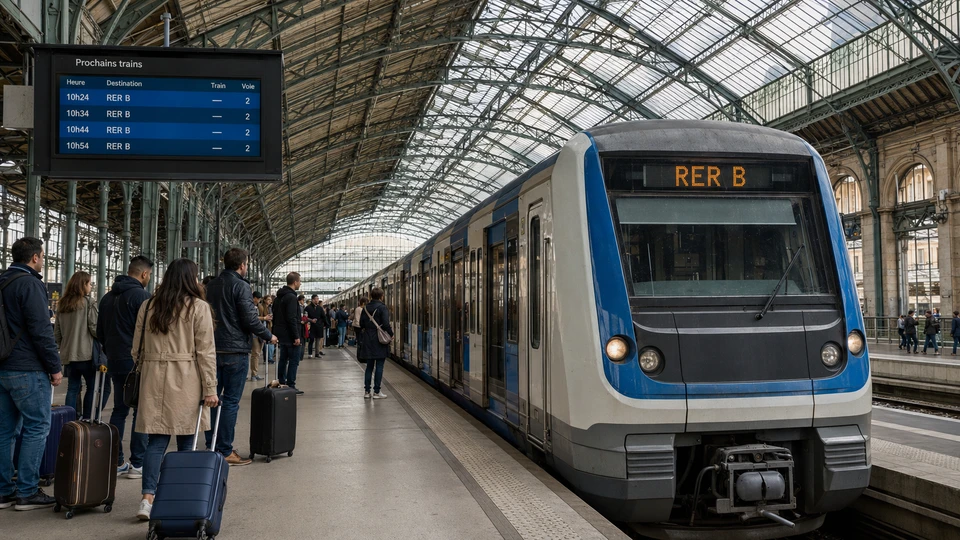
When you arrive at Orly, you go through the arrival area past the Orly 4 arrivals hall and the first thing you notice is a row of signs—there are ones for the métro, the RER, the taxi rank and the car rental desks. The signs do not have "Champs-Élysées" in large, friendly letters since there is no direct connection; the distance is about 18 km (11.4 miles) from door to door and, depending on the mode of transport, the journey takes anywhere from 25 minutes to well over an hour. This guide is aimed at anyone flying into Orly who wishes to be walking past the Arc de Triomphe with as little trouble as possible—whether that is a family travelling with a stroller and three suitcases or an individual who is happy to navigate the métro on their own. Although a pre-booked private transfer gets rid of most of the uncertainty, it is not the only reasonable choice, and we will be honest about the situations in which it is not necessary.
Quick Answer: The Best Way from Orly Airport to Champs-Élysées
For most travellers, a private transfer (€€) offers the best compromise between speed and comfort, providing door-to-door service in about 25 to 40 minutes with a driver already waiting at the arrival point. The cheapest option is to take Metro Line 14 to Châtelet and then switch to Line 1 at George V (€), which takes around 35 to 45 minutes with one change. The fastest journey on a clear day is by taxi (€€€) at 20 to 30 minutes, although this figure is optimistic when you take into account the taxi queue.
| Distance | Fastest option | Cheapest option | Most comfortable |
|---|---|---|---|
| ~18 km / 11.4 miles | Taxi (€€€, about 20 to 30 min) | Metro 14 plus Metro 1 (€; about 35 to 45 min) | Private transfer (€€, door to door) |
Understanding the Orly Airport → Champs-Élysées Route
Orly is located to the south of Paris in the Val-de-Marne department, and the Champs-Élysées passes through the 8th arrondissement heading towards the Arc de Triomphe in the northwest part of the city—thus, no matter which direction you take, you have to cross the entire city diagonally. The importance of this is greater than it may appear: simply because your flight is short does not mean that your transfer will be short.
When arriving by road, drivers usually take up the A6a motorway near Porte d'Orléans (or the A6b through Porte de Gentilly) and then proceed according to the signs onto the A106 to get to the airport. On their way back into Paris, the same section of road joins the Boulevard Périphérique, and those drivers going towards the Champs-Élysées generally take the western arc which passes through Porte de Vanves and goes on towards Porte Maillot before descending onto either Avenue Foch or Avenue de la Grande Armée, ending up at the Arc de Triomphe roundabout. The journey is smooth outside of the rush hour but becomes a real ordeal between about 7:30 and 9:30 AM and from 5 to 7:30 PM, since the Périphérique becomes heavily congested around Porte d'Orléans and Porte de Vanves.
There is no direct rail connection; each train or métro line arriving in central Paris from Orly requires at least one change, a circumstance that surprises many first-time visitors who suppose that in a capital city the airport should have a shuttle service to the centre.
Your Transfer Options, One by One
Here comfort is more expensive, and the amount of time you're prepared to stand on a platform with your luggage should determine which option you choose.
Metro Line 14 + Metro Line 1
Verdict: It's cheap and fast once you're on it, but you should expect stairs.
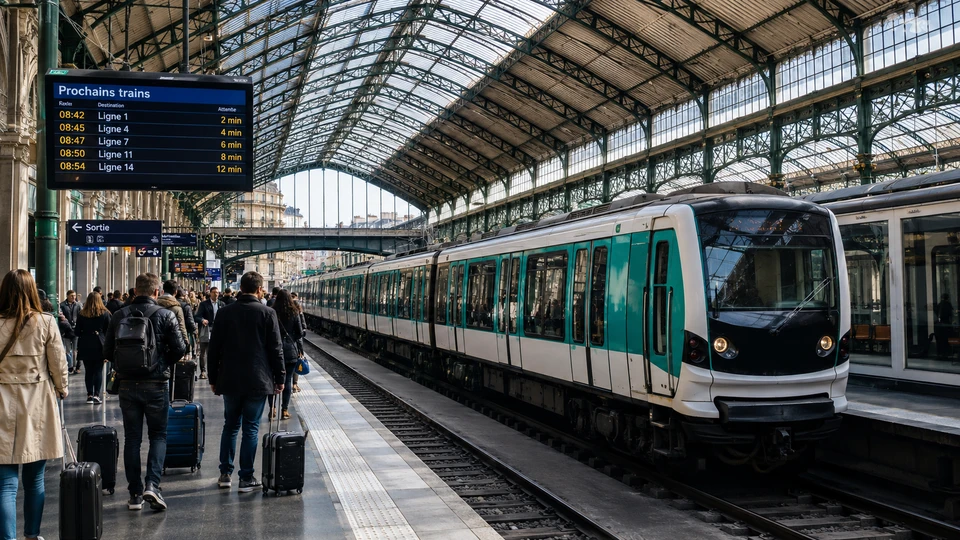
Since the 2024 extension, Line 14 has run directly to Orly Airport and takes about 25 minutes to reach Châtelet–Les Halles. At Châtelet, you must change to Line 1 and get on it to go to George V, Franklin D. Roosevelt, or Charles de Gaulle–Étoile according to where along the avenueAll inre going. In total, al,low between 35 and 45 minutes for the journey including the change.
- Fully automated, frequent trains (every 1–2 minutes on Line 14)
- One change at a genuinely huge, well-signed station
- Cheapest way into central Paris, hands down
Advantages: It is fast, reliable, and does not have to deal with road traffic at all.
Drawbacks include the fact that the stairs and escalators at the Châtelet connect with large luggage; they can become crowded during peak hours; and they are not suitable after an overnight flight when all you want to do is sit down.
Orlyval + RER B
Verdict: A good backup, though it does come with one additional ticket to consider.
The Orlyval shuttle takes about eight minutes to get you from the terminals to Antony station, where you can board the RER B bound for central Paris (either Saint-Michel–Notre-Dame or Châtelet) and then have to make another connection by métro if you want to go on to the Champs-Élysées. It's a sensible alternative should there be engineering works on Line 14, but it is never quicker than taking Line 14 directly.
- Orlyval requires its own separate ticket on top of your RER/métro fare — a quirk that catches people out
- Useful if you're already staying near the RER B corridor (Denfert-Rochereau, Luxembourg)
Pros: Shuttle runs often. It usually works even when there are problems.
Drawbacks: It involves buying an additional ticket, requiring an extra change, and is usually slower than Line 14 for this particular destination.
You can check official train schedules and connections on the SNCF timetable page
Private Transfer
Verdict: The one to book if you don't want to consider any of the points mentioned above.

A private transfer will come and pick you up in the arrivals hall—since Orly's terminals were merged into Orly 1, 2, 3, and 4 in 2019, there's no longer any need to try to work out whether you're at 'Sud' or 'Ouest'—your driver will be keeping track of your flight and will take you straight to the door of your hotel or apartment on or near the Champs-Élysées, with no need to change vehicles, no stairs, and no waiting in line.
- Fixed price agreed before you fly, regardless of how bad the Périphérique traffic is that day
- One vehicle covers the whole group, so luggage and buggies aren't a problem
- Genuinely useful for late-night or early-morning arrivals when public transport is either shut or unreliable
Advantages: The service is door-to-door, has a fixed price, and requires no connections.
Cons: It costs more than using public transport on a per-person basis when travelling alone; it is necessary to book in advance rather than turning up and taking the cheapest option available.
Taxi from the Rank
Verdict: It's all right provided that there is no queue—and there usually is one.

On the official basis licensed taxis which go from Orly to central Paris charge a fixed fee rather than using a meter, a feature which in this case is advantageous since you know the price before getting in the taxi. In reality, however, arriving in the evening can result in having to wait actually at the taxi rank, particularly in the area of Orly 4.
- Flat fare removes metered surge worry
- No pre-booking needed
- Comfort depends entirely on which taxi you get
Pros: You do not need to book in advance for this route, the fare is flat, and there is a direct drop-off.
Cons: It is impossible to predict the length of the queue, the driver might not speak much English, and there is no guarantee that the boot will be large enough for the four passengers' luggage.
Ride-Hailing App
Verdict: Handy, but prices change with demand.

Ride-hailing services work from the designated pick-up areas at Orly and can serve as a reasonable compromise—you have an idea of the price before confirming, even though it goes up during surge periods (for arrivals on Friday evenings and during as fixed asays). They are not fixed like rivately booked transfer.
Advantages include the fact that it is app-based, doesn't require cash, and has live driver tracking.
Cons: There may be surge pricing during peak times and the designated pickup point could mean that you have to walk an extra distance from the arrival point.
Side-by-Side Comparison
| Option | Door-to-door time | Price level | Luggage | Transfers needed | Best for |
|---|---|---|---|---|---|
| Metro 14 + Metro 1 | 35–45 min | € | Awkward with more than 1 bag each | 1 change | Solo travellers, light packers |
| Orlyval + RER B | 45–60 min | € | Awkward | 2+ changes | RER B corridor stays, backup route |
| Private transfer | 25–40 min | €€ | Easy — full boot space | None | Families, groups, late arrivals |
| Taxi | 20–30 min (traffic-dependent) | €€€ | Depends on vehicle | None | No-booking-needed convenience |
| Ride-hailing app | 20–35 min | €€–€€€ | Depends on vehicle size | None | Solo/pairs comfortable with apps |
Which of the options is right for you?
For families with small children: it's best to avoid using the Châtelet interchange when travelling with a stroller and a diaper bag since a private transfer with an appropriate child seat already fitted is worth every euro on this route.
For couples going on their first visit to Paris the metro is really satisfactory provided that you are travelling with only light luggage, but if you have a private transfer then the first view of Paris you get is the Périphérique merging into Avenue Foch, not a crowded platform.
When travelling in groups of four or more, a €€ private transfer usually ends up being cheaper per person than four separate € métro fares when you work out the cost of the individual tickets, and no one has to carry a bag up the stairs at Châtelet.
For people on a budget: take the Line 14 to Châtelet and then the Line 1, since it's quick, cheap, and in fact the best option if you're only carrying one bag and aren't minded to spend some time navigating.
People who have a lot of luggage: once you have to change trains on the métro, the situation becomes a nuisance quite quickly. A transfer that has actual space for boots will save both your arms and your patience.
With arrivals either in the late evening or in the early morning, the Métro service becomes sparse and does not resume until the early hours, which is why a pre-booked transfer together with flight tracking is worthwhile, since the driver makes allowance for a delayed landing.
The Case for Booking a Private Transfer with Top Paris Transfer
The calculations are different when there are two or more people involved. Four members of a family paying separately for metro tickets may find themselves paying almost the same amount as a single €€ private transfer for the whole group — with the exception that the transfer includes a driver who is waiting at the Orly arrivals, your flight being already tracked, and there being no stairs between the plane and the car.
Fixed pricing is also a key point. Taxis on this route have a flat rate as well, and that is reasonable, since if your flight is delayed you won't be surprised by any price increases because the transfer price is fixed before you have even landed — especially if you end up having to navigate rush-hour traffic on the Périphérique. Child seats can be provided upon request, there's no difficulty with luggage space, and 24-hour support is available should your gate change or your bag fail to appear on the conveyor belt.
A common situation is this: a family arriving on a Friday evening in December lands at Orly 4 just as the Christmas illuminations along the Champs-Élysées are causing a surge in traffic on the avenue. If they use public transport, the result is a tired toddler in a crowded carriage on line 14. With a private transfer, instead, there is a driver already waiting with a name board, a car seat in place, and a direct journey – even though it may take a bit longer than normal due to the crowd of lights, at least everyone will be seated.
👉 Book a private transfer from Orly Airport to the Champs-Élysées with Top Paris Transfer at a fixed price, with the driver waiting for you at the arrivals hall.
When to Travel: Traffic & Timing on This Route
The morning peak hour (about 7:30 to 9:30 AM) has the greatest effect on the southern and western sections of the Périphérique, especially in the area around Porte d'Orléans and Porte de Vanves—precisely the section that is used by a road transfer. The evening peak (from 5 to 7:30 PM) is equally bad when travelling in the opposite direction. For a swift road trip, the best times are midday and late in the evening; since the métro is underground, it is unaffected by these variations and maintains approximately the same journey time throughout the day.
A noteworthy seasonal feature is that the Champs-Élysées is partly turned into a pedestrian zone or becomes very crowded during the December illuminations and on New Year's Eve, when access to the road near the Arc de Triomphe is closed off for the crowds. So, whenever you are arriving during that period, allow yourself extra time no matter which option you take.
What This Route Really Costs (Including the Costs Nobody Mentions)
When it comes to public transport in terms of cost, the value is outstanding since a standard métro/RER ticket includes both Line 14 and Line 1. For the Orlyval + RER B route, an extra shuttle ticket must be purchased on top of your normal fare, a charge that people usually fail to take into account. Taxis and ride-hailing services (€€–€€€) charge a fixed or fare quoted by the app for this route, so at least you won't have to watch the meter go up in traffic — although ride-hailing prices do increase during periods of high demand. A private transfer (€€) falls somewhere in the middle when it comes to price per booking, but per person in a group it often ends up being cheaper than if each person had bought their own public transport ticket once you consider that the fee is based per vehicle rather than per person.
The actual hidden cost of this route is the time spent at the interchanges—if you miss a connection at Châtelet during a busy time it could easily amount to 15 to 20 minutes that you didn't anticipate.
As for the real cost, if you're travelling alone and with only light luggage, then public transport is clearly the bett Private B transfering with two or more people and have luggage, the per-vehic won't have to carry private transfer generally comes out cheaper than buying separate tickets, not to mention the fact that you won't have to carry your bags through a métro interchange to prove it.
Mistakes to Avoid on the Orly Airport → Champs-Élysées Journey
- **If there is a **direct train or bus, there isn't because all public transport routes require at least one change, and the Orlybus (the previous direct bus service to Denfert-Rochereau) ceased operation in March 2025.
– Since the Orlyval requires its own ticket, when you take the route combining the Orlyval and the RER B you should buy an extra fare in addition to your normal Paris transport ticket. - Going to the wrong Orly terminal for pickup. Since 2019 the terminals at Orly have been numbered Orly 1, 2, 3 and 4 so make sure you check your terminal number rather than the previous "Sud/Ouest" name, which is still shown on some older maps and apps.
- If you have a lot of luggage when using the Châtelet interchange it's a mistake. It's a large station and there are quite long distances to walk between the platforms — that's not a problem if you're carrying a backpack but becomes more difficult when you have two large cases.
– When attending the December illuminations without extra time, road access close to the Arc de Triomphe becomes restricted due to the large number of people during the peak lighting period and on New Year's Eve. - Since you are arriving late at night and expecting the métro to be frequently running, note that Line 14 does not operate all night — it is necessary to check the last-train times before using it for a late arrival.
- When booking a taxi you should be ready for a meter. Since this route has a fixed fare from the airport, it should come as no surprise (and you should not be undercharged in expectation) if it is given as a single price.
FAQ
Is there a direct train from Orly Airport to the Champs-Élysées?
No. The quickest public transport route is Metro Line 14 into Châtelet-Les Halles. Then take Line 1 to George V or Charles de Gaulle-Étoile. You only need to change trains once. The trip takes about 35 to 45 minutes total.
What is the fare for a taxi from Orly to the Champs-Élysées?
On this route licensed taxis use a fixed fare (€€€) instead of a meter, so you'll know the price before getting in—be sure to ask your driver to confirm it beforehand.
What became of the Orlybus?
The closure was final on 3 March 2025 since the extension of Metro Line 14 to Orly rendered the bus mostly obsolete – there is no direct bus service replacing it into central Paris.
At which Orly terminal will my private transfer collect me?
In 2019 the various terminals at Orly were combined into one layout known as Orly 1, 2, 3, 4, and therefore your driver will pick you up in the arrival area of the terminal to which you have been assigned rather than in an old 'Sud' or 'Ouest' hall.
Should the Orlyval be taken rather than the métro?
Disruptions only affect those who are staying near the RER B line or Line 14; the route from Orlyval to Antony, via the RER B, is generally slower when travelling to the Champs-Élysées than taking the direct route on Line 14, and iit n that case a separate ticket is required.
How long does the journey from Orly to the Champs-Élysées really take?
It can take about 20 minutes during a quiet midday run. During Périphérique rush hour, it can take 45 minutes or more, especially near Porte d'Orléans and Porte de Vanves.
Is a private transfer worth it for a solo traveller?
Honestly, not always — if you're travelling light and can comfortably manage one métro change, public transport is genuinely the smarter budget choice solo. It makes far more financial and practical sense once you're travelling as two or more with luggage.