Orly Airport to Boulogne-Billancourt: Every Transfer Option Compared (2026 Guide)

When you arrive at Orly, cross the walkway beyond Hall 4, and your phone will display a message from your Airbnb host near Pont de Sèvres. Although the place is 19 km away, there is no direct train, and you aren't certain if the journey will take twenty minutes or one hour. It all comes down to the choice you make next.
The journey from Orly Airport to Boulogne-Billancourt is about 19 km (approximately 12 miles) and, on a clear stretch of road, lasts between 20 and 30 minutes. However, during rush hour the journey takes longer. This guide is aimed at anyone arriving at Orly — whether they are travelling alone, with their family, or are carrying a full trolley of luggage — who wants to know precisely how to get to Boulogne-Billancourt without having to guess. Although booking a private transfer removes uncertainty, it's still wise to understand the situation first.
Quick Answer: The Best Way from Orly Airport to Boulogne-Billancourt
For most travellers, a private transfer (€€) represents the best compromise between speed and comfort since the driver will meet you at the airport and take you directly to your door in Boulogne-Billancourt. Taxis (€€€) offer the same level of speed but at a higher price. For a single traveller carrying only light luggage, public transport (€) is feasible, though it involves two changes and takes almost an hour from door to door.
| Distance | Fastest option | Cheapest option | Most comfortable |
|---|---|---|---|
| ~19 km / 12 miles | Taxi or private transfer (~20–30 min) | Metro (line 14 + line 9) | Private transfer |
Understanding the Orly Airport → Boulogne-Billancourt Route
Orly is located in Val-de-Marne, south of Paris, while Boulogne-Billancourt is almost directly to the west, on the opposite side of the city in Hauts-de-Seine—thus, this is not just a short journey across one suburb but involves a diagonal crossing which follows the southern and western edges of Paris rather than going through the centre.
Usually, drivers take the A106 link road from the airport, merge onto the A6a, then take the A86 ring road towards the west before descending towards either Pont de Sèvres or Porte de Saint-Cloud in order to enter Boulogne-Billancourt. The A86 in this area is notorious for having slow sections in the early evening, especially in the section which directs traffic towards the Seine crossings.
There is no direct train or RER service between the two places. The most practical public transport route involves the extension of Metro Line 14, which now goes directly to Orly Airport, with a transfer in central Paris to Line 9, whose terminus is Pont de Sèvres—right on the border of Boulogne-Billancourt, next to the Seine.
Your Transfer Options, One by One
Here, there is a fairly predictable relationship between price and comfort, but it's up to you which option is better depending on your luggage, how much time you're willing to spend changing, and when you arrive.
Private Transfer
Something that is feasible and, when it comes to people who are arriving with suitcases, by a large amount the simplest option.

A private driver will be waiting for you at the arrivals hall of Orly, either at Hall 4 or at Halls 1-2-3 according to the terminal you use, will follow your flight, and will take you directly to your address in Boulogne-Billancourt—there will be no need to change vehicles or to go up stairs with your suitcase. The duration of the journey is the same as that of a taxi, taking about 20 to 30 minutes depending on traffic on the A86.
- Price level: €€, quoted per vehicle, not per person
- Luggage: Full boot space, no restrictions
- Best for: Families, groups, late arrivals, anyone who wants zero decision-making after a long flight
Pros
- Fixed price agreed before you land
- Door-to-door, no transfers
- Driver waits even if your flight is delayed
Cons
- Costs more than public transport
- Needs booking ahead for guaranteed pickup
Taxi
You may book quickly, but you'll have to pay a premium in order to avoid making advance reservations.
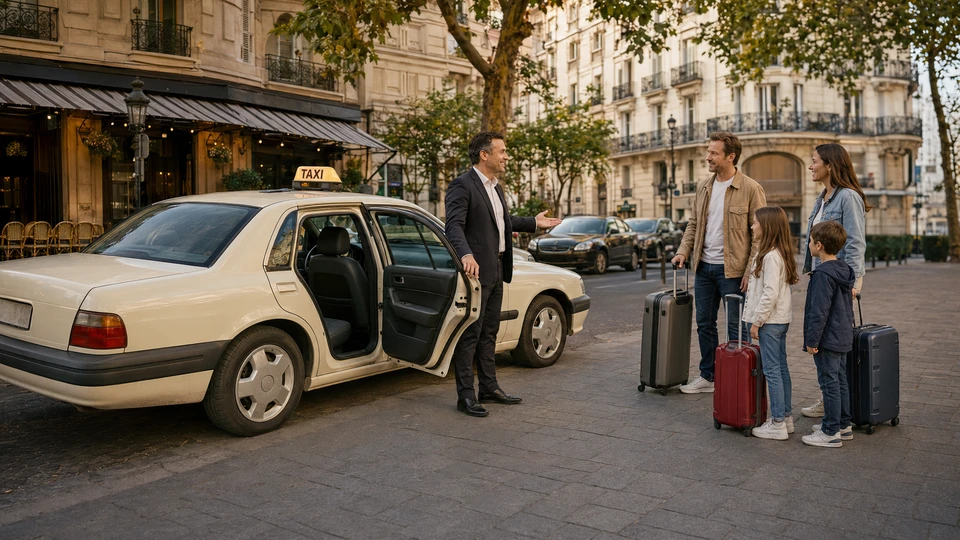
Official taxis wait in queues outside each terminal. On this route the fare is not fixed since it is based on the meter, which means that spending a long time travelling along the A86 during the evening rush hour will increase the total charge unlike a fixed-price transfer.
- Price level: €€€, per vehicle
- Luggage: Standard boot space, may be tight for a group of four with large cases
- Best for: Solo or paired travelers who didn't book ahead and want speed now
Pros
- Available on demand, no wait for booking confirmation
- Similar journey time to a private transfer
Cons
- Metered fare can climb if traffic on the A86 is bad
- Queue length at the taxi rank varies unpredictably, especially after a wave of evening arrivals
Metro (Line 14 + Line 9)
Very good as long as you're carrying only light luggage and are willing to make one change.
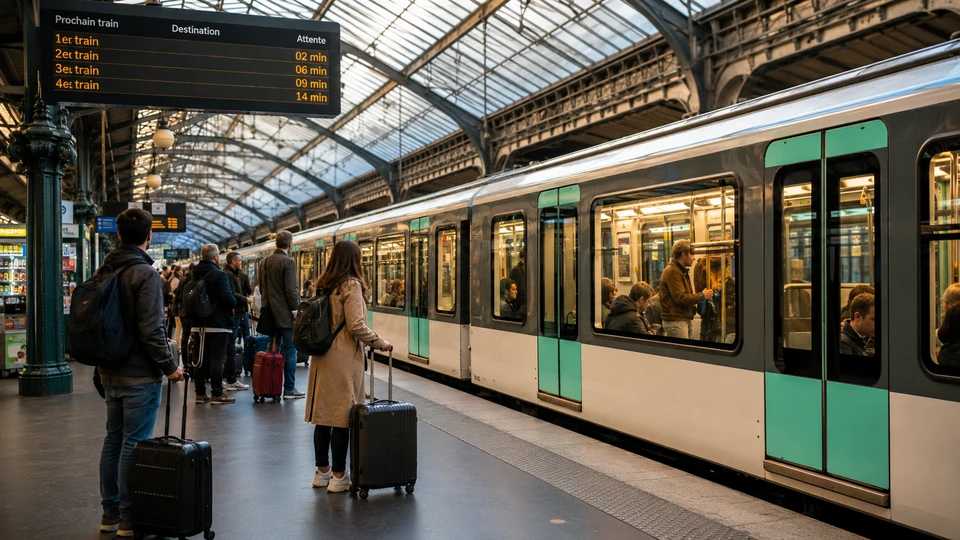
As the extension of line 14 now goes all the way to Orly, this has become the simplest public transport route. You take line 14 into central Paris, change over (usually at Saint-Lazare or Havre-Caumartin) to line 9 and travel on it to its western ending at Pont de Sèvres — or get off at Billancourt or Marcel Sembat, both of which are located in Boulogne-Billancourt. The total time for the journey is about an hour when allowing for the change.
- Price level: €, per person
- Luggage: Fine for a backpack or one rolling case; a real struggle for a family with four large suitcases and stairs at the interchange
- Best for: Solo budget travelers, anyone comfortable navigating one metro change
Pros
- Cheapest option by far
- Frequent trains, no need to pre-book
- Drops you inside Boulogne-Billancourt itself, not just nearby
Cons
- Nearly an hour door-to-door once you count the walk and change
- Not realistic with more than one large bag per person
Bus
It is technically possible, but not worth the effort for the majority of travelers on this particular route.
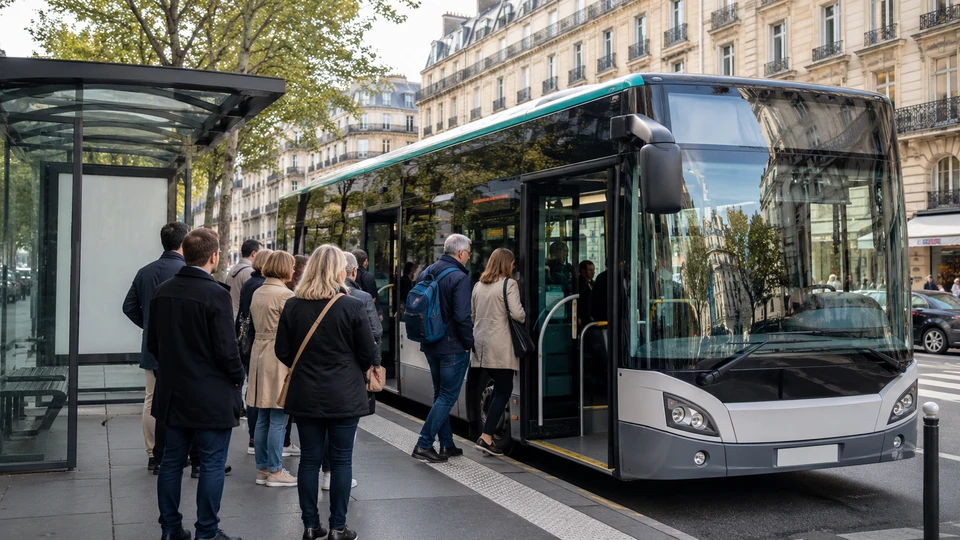
There is just as much a direct bus service. The routes require a change of bus, usually at Porte d'Orléans or at the Marché International de Rungis, and the total travel time ranges from about one hour twenty-five minutes to one hour thirty minutes. Since the metro covers the same distance more quickly, the bus only really makes sense if you are already close to one of the stops that it serves.
- Price level: €, per person
- Luggage: Same practical limits as the metro, plus longer waits at street-level stops
- Best for: Very budget-conscious travelers with no time pressure
Pros
- Cheapest ticket price of any option
- No stairs at some stops, unlike certain metro interchanges
Cons
- Longest journey time of any realistic option
- Transfer point can mean a wait, especially outside peak service hours
Ride-Hailing
A sensible compromise when you already have the app and do not wish to wait for an official taxi.
Uber and other similar services have a designated pickup area at Orly instead of using the taxi rank. Their prices and the time taken for the journey are similar to those of a taxi, although they may be slightly lower depending on the level of demand at the time you arrive.
- Price level: €€, per vehicle
- Luggage: Standard car boot, same limits as a taxi
- Best for: Travelers who want a fixed-ish estimate before booking and are comfortable with app-based pickup
Pros
- Price estimate shown before you confirm
- No physical queue to stand in
Cons
- Surge pricing can apply at busy arrival times
- Pickup point can be a longer walk than the taxi rank
Side-by-Side Comparison
| Option | Door-to-door time | Price level | Luggage | Transfers needed | Best for |
|---|---|---|---|---|---|
| Private transfer | ~20–30 min | €€ | Full boot, no limit | None | Families, groups, late arrivals |
| Taxi | ~20–30 min | €€€ | Standard boot | None | Solo/paired, no pre-booking |
| Metro (14 + 9) | ~55–60 min | € | Light bags only | 1 | Budget solo travelers |
| Bus | ~1h25–1h30 | € | Light bags only | 1 | Very budget-conscious, no rush |
| Ride-hailing | ~20–30 min | €€ | Standard boot | None | App users wanting an estimate |
Which of the options is right for you? (Match according to traveler type)
For families with young children: it's best to avoid using the metro interchange since you'll be pushing a stroller and having the cases as well. If you book a private transfer with a child seat in advance, you'll eliminate the most troublesome aspect of this route.
Four or more people: Although four metro tickets do add up in terms of both time and money because of the need to change trains, a private transfer, which is charged on a per-vehicle basis, usually ends up being cheaper per person than four individual train fares, and no one has to carry a suitcase up the stairs at Havre-Caumartin.
For people on a tight budget: if you have just one bag and are willing to make one change, the metro is really acceptable here since it is the cheapest option for getting across the diagonal to Pont de Sèvres.
For business travelers, if you have a fixed-price transfer with flight tracking then you won't be charged a metered fare if your meeting involves you waiting and the A86 is slow that evening.
For arrivals in the late night or early morning: the frequency of Metro and bus services decreases outside normal hours, but a pre-booked transfer will still be there no matter when your flight actually lands.
Travelers with lots of luggage: The car-based options (transfer, taxi, ride-hailing) are the only realistic choice once you're past two large suitcases.
For those visiting Paris for the first time, asking them to cope with an unfamiliar metro station right after a long-haul flight is a great deal to expect. The stress of the first day can be eliminated by a driver who has a sign and is stationed at the arrivals area.
The Case for Booking a Private Transfer with Top Paris Transfer
The cost of four separate metro tickets for a family of four, together with the hassle of dealing with bags when changing trains, is usually about the same as that of a single €€ private transfer for the entire group, with no one having to go up or down a staircase, and it's this per-person calculation that usually decides the matter.
Since your driver is tracking your flight, a delayed landing does not mean that the pickup will be missed because they will still be waiting at the agreed meeting point in Hall 4 or in Halls 1-2-3. The price was fixed and agreed upon before you landed, so you won't have to watch the meter go up if the A86 backs up near Pont de Sèvres on a Friday evening. Features such as child seats, additional luggage space, and 24 hour availability are included as standard features, not as optional extras.
A common situation on this route is this: a couple arrive at Orly on a delayed evening flight, tired, together with a toddler and two big suitcases, and are going to an apartment close to Marcel Sembat. By now the metro's last convenient link has become less frequent. A driver who is waiting at the arrival hall with a car seat in the car manages to turn what would have been a stressful final journey into a 25-minute drive right to the door.
👉 Book a private transfer from Orly Airport to Boulogne Billancourt with Top Paris Transfer: the price is fixed and the driver will be waiting for you at the arrivals hall.
When to Travel: Traffic & Timing on This Route
The A86 is usually the smoothest to drive in the early morning (before 7:30 AM), the journey falling at the lower end of the 20 to 30 minute period. Traffic at midday is generally moderate, while in the evening, from about 5 PM to 7:30 PM, the A86 near the Seine crossings leading towards Boulogne-Billancourt tends to slow down most noticeably, occasionally bringing a drive that takes twenty minutes up to forty minutes.
It's worth noting a seasonal consideration: since Roland-Garros takes place each spring and is situated near this route, it causes a noticeable increase in traffic on the roads that lead west from the city during the week of the tournament—so it's important to allow for extra time if your dates coincide.
What This Route Really Costs (Including the Costs Nobody Mentions)
The fare for the metro and bus is €, with the cost charged on a per-person basis — although it is cheap when taken alone, it becomes expensive for a group, and the price does not differ whether you are travelling with one bag or four bags. Taxis and ride-hailing services are priced at €€ to €€€ and are charged on a per-vehicle basis, taxis also involving an extra element of uncertainty due to the use of a meter whose charge can vary according to traffic conditions. Private transfers are at €€ as well, on a per-vehicle basis, but the price is fixed before you travel.
When taking this route, there are hidden expenses such as the additional minutes (and stress) involved in going up and down the stairs at a metro station where you have luggage, not to mention the simple truth that if a flight is delayed the entire cheap public transport arrangement can turn into a last-minute panic when the services become fewer. For an average group of three or four people who have luggage, when the true cost is compared—taking into account time, the inconvenience, and the amount of transport tickets needed per person—the private transfer is generally the better option once all these factors are considered, not just when looking at the printed price.
Mistakes to Avoid on the Orly Airport → Boulogne-Billancourt Journey
- If there is a direct train — there isn't, since all the public transport routes from Orly to Boulogne-Billancourt require at least one change.
– Underestimating the metro interchange when carrying luggage. The change at Saint-Lazare or Havre-Caumartin requires walking and using stairs that are not suitable for a full-size suitcase.
— Without taking the evening traffic on A86 into account, a journey that should take twenty minutes may last over thirty minutes when travelling between 5 and 7:30 PM. - Heading to the wrong terminal hall. Arrivals at Orly are spread across several halls; make sure you know which hall your flight uses before choosing a meeting place.
- If you book a taxi without looking at the queue, the length of the queue can vary considerably depending on how many flights have just landed.
- If your trip overlaps with the Roland-Garros week, ignore it. Traffic on the roads west of the city increases noticeably during the tournament.
– Assuming that, in terms of travel, Boulogne-Billancourt is just outside Paris. It involves a true diagonal crossing of the city, not just a short journey between two suburbs.
FAQ
Does a direct train run from Orly Airport to Boulogne-Billancourt?
On the contrary, the most practical route for public transportation is to take metro line 14 from Orly to Linas and then switch to line 9 to go to Pont de Sèvres, Boulogne-Billancourt, or Marcel Sem,bat—this takes about 55 to 60 minutes including the change.
What is the fare for a taxi from Orly to Boulogne-Billancourt?
Taxis in this area are metered rather than charging a fixed rate, the fare being in the €€€ range. The amount you have to pay will depend on the traffic conditions on the A86 and thus can differ between a quiet morning and a busy evening.
What is the time taken to travel from Orly Airport to Boulogne-Billancourt?
If you travel by car—whether using a taxi, a private transfer or a ride-hailing service—you can expect the journey to take between 20 and 30 minutes assuming normal traffic conditions. If you take the metro, allow almost an hour once you have added on the time needed to change trains and the time spent walking.
What metro stations in Orly serve Boulogne-Billancourt?
The ninth line has three stations in Boulogne-Billancourt—Marcel Sembat, Billancourt, and its western terminus, Pont de Sèvres—and can be reached from Orly by changing from line 14 in central Paris.
Should a private transfer be worthwhile for a family?
Yes, for most families with young children and who have several bags, the cost per vehicle is usually about the same as the total of a number of separate metro or taxi fares, since no one has to deal with stairs or make a change while pushing a stroller.
Is the traffic going to become bad on this route?
The A86, which is most commonly used by motorists as part of their journey, tends to slow down noticeably on weekday evenings between about 5 and 7:30 PM, especially in the area near the Seine bridges leading towards Boulogne-Billancourt.
Does a direct bus exist?
No direct bus service covers this route. Bus options involve a transfer and typically take 1 hour 25 minutes to 1 hour 30 minutes — longer than the metro for the same money.
What's a landmark I'd pass on this route?
Heading in via Pont de Sèvres, you'll cross the Seine right next to Île Seguin, the island that once housed the Renault car factories and now hosts La Seine Musicale concert hall.
Other Popular Blog You Might Need
- Orly Airport to Hotel Santa Fe: Every Transfer Option Compared (2026 Guide)
- Orly Airport to Hotel Cheyenne: Every Transfer Option Compared (2026 Guide)
- Best Ways to Get From Orly Airport to B&B Hotel Disneyland: Every Transfer Option Compared (2026 Guide)
- Orly Airport to Gare du Nord: Every Transfer Option Compared (2026 Guide)