Gare de Lyon to Charles de Gaulle Airport: Every Transfer Option Compared (2026 Guide)

You have just got off a TGV at Gare de Lyon, holding your suitcase in one hand and your boarding pass for a flight to CDG in the other. The clock has already started.
The journey from Gare de Lyon to Charles de Gaulle Airport involves a distance of about 30 to 35 km and, in reality, takes between 40 minutes and more than an hour depending on the method of travel and the time of day. Since there is no one correct option, the choice comes down to the amount of luggage you have, your budget, and how much stress you are prepared to endure on the way.
The guide applies to all those who are travelling by train from Gare de Lyon directly to a flight at CDG, regardless of whether they are a single person with a backpack or a family who has three suitcases and a toddler. If you prefer to avoid making any decisions, a pre-booked private transfer will collect you at the platform exit and eliminate the need to decide.
Quick Answer: The Best Way from Gare de Lyon to Charles de Gaulle
The best and most comfortable choice is to take a private transfer or taxi (costing €€–€€€), the journey taking 35 to 50 minutes from door to door depending on traffic conditions. The cheapest option is the combination of the RER A and RER B trains (at €), which takes about 50 to 60 minutes including the change at Châtelet-Les Halles. When it comes to travelling with a group or with heavy luggage, a private transfer generally provides better comfort and a lower cost per person.
| Distance | Fastest option | Cheapest option | Most comfortable |
|---|---|---|---|
| ~30–35 km | Private transfer / taxi | RER A + RER B train | Private transfer |
Understanding the Gare de Lyon → CDG Route
Gare de Lyon is located in the 12th arrondissement, on the Right Bank of the Seine, some way to the southeast of central Paris; CDG is about 30 km to the northeast, therefore the route goes right across the city.
When taking the road, cars and taxis usually join the Boulevard Périphérique close to Porte de Bercy and then go north on the A1 motorway, the Autoroute du Nord, which goes almost directly to the airport. Although this route seems fast in theory, the Périphérique is well known for being unpredictable during peak hours.
There is no direct train service; in fact, all the rail options, if you exclude the private transfer, take you through central Paris first.
The RER A leaves under Gare de Lyon and arrives at Châtelet-Les Halles after a short journey. At this point, you go over the platform (without having to use the stairs) to board the RER B which is bound for CDG. This is a standard commuter line, not a tourist service, so it will feel just like a typical commuter route.
Your Transfer Options, One by One
Each option involves a different degree of compromise between speed, cost, and comfort—here is how each one performs in the case of this particular route.
RER A + RER B (Train)
It's suitable for a single traveller carrying one bag and having a bit of patience; however, it's not so suitable if you have a toddler and two suitcases.
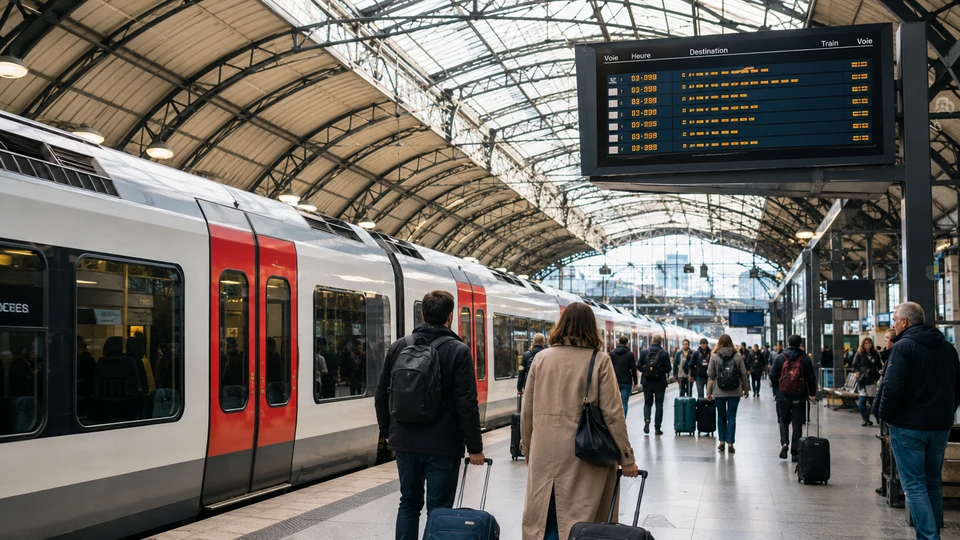
Take the RER A and alight at Châtelet-Les Halles, cross the platform, then get on the RER B bound for the north. When you pass Aulnay-sous-Bois the RER B divides into two lines, so make sure you check the platform display — one line serves CDG and the other goes to Mitry-Claye — because you don't want to discover this to your disadvantage.
The trains generally run at intervals of about 10 to 15 minutes, from 5 a.m. until midnight, and the total travel time is usually between 50 and 60 minutes, including the time taken to change trains.
- Pros: Cheapest option by far (€); frequent departures; avoids road traffic entirely
- Cons: Two changes with luggage; stairs and crowds at Châtelet-Les Halles; no seat guarantee at peak times
You can check official train schedules and connections on the SNCF timetable page
Taxi
Possible and in fact quite simple if you don't plan on thinking about it.

There are official taxi ranks located directly outside Gare de Lyon; the prices for taxi rides from central Paris to CDG are based on a flat-rate system rather than a meter, and since Gare de Lyon is on the Right Bank, you fall into the lower of the two flat-rate categories. The journey usually takes between 35 and 50 minutes by means of the A1, but it will take longer if you encounter rush hour on the Périphérique.
- Pros: No booking needed; flat fare removes surprise costs; direct door-to-door
- Cons: Queue length at the rank varies wildly; price is fixed per vehicle, not always ideal value for a solo traveller; drivers won't track your flight if you're running early
Private Transfer
The one that you book in advance and afterwards cease to think about.

You will be collected at a predetermined meeting point outside Gare de Lyon at the agreed time without having to queue or wait for a rank. The price is set before your journey begins and is given on a per-vehicle basis rather than on a per-person basis, with the driver adjusting the pickup time to match your train rather than your train adjusting to the driver's schedule.
- Pros: Fixed price agreed upfront; per-vehicle pricing works out well for groups; driver waits even if your train is delayed
- Cons: Costs more than the train for a solo traveller; needs booking ahead rather than turning up on the day
Bus (FlixBus)
A less noisy option which most people never consider, and in truth it's all right if you aren't in a hurry.

A bus that goes directly from Quai de Bercy, which is a short distance from Gare de Lyon, to CDG runs about once an hour. The travel time is approximately 45 minutes to just over an hour, depending on traffic, because it uses the same roads as taxis.
- Pros: Direct, no changes; usually the second-cheapest option (€)
- Cons: Hourly departures mean you might wait a while; luggage space is limited compared with a private vehicle; subject to the same road traffic as taxis
Ride-hailing (Uber, Bolt)
It works okay as long as you are comfortable using an app and do not mind the cost.

Hailing services are available all over central Paris and can be arranged right outside Lyon Station. The time taken is similar to that of a taxi, amounting to about 35 to 50 minutes, but the prices vary depending on demand—they will rise considerably during the morning peak hour or in bad weather.
- Pros: Easy to book from your phone; price shown upfront per trip
- Cons: Surge pricing can push costs above a fixed taxi fare; driver availability isn't guaranteed at 5am; less luggage space in standard cars
Side-by-Side Comparison
| Option | Door-to-door time | Price level | Luggage | Transfers needed | Best for |
|---|---|---|---|---|---|
| RER A + RER B | 50–60 min | € | Limited, stairs involved | 1 (at Châtelet-Les Halles) | Solo travellers, light packers |
| Taxi | 35–50 min | €€ | Good | 0 | Anyone wanting simplicity |
| Private Transfer | 35–50 min | €€–€€€ | Best | 0 | Families, groups, early flights |
| Bus (FlixBus) | 45–65 min | € | Moderate | 0 | Budget travellers with time to spare |
| Ride-hailing | 35–50 min | €€ (variable) | Good | 0 | Tech-comfortable solo/couple travellers |
Which of the options is right for you?
For families who have small children the changing of the platform and the stairs on the train are a real trouble when using a pram. If you have a private transfer with an appropriate child seat, then this problem is completely eliminated.
If you book in groups of four or more you'll get four separate transfers at a rate that is usually cheaper per vehicle than buying four individual train or bus tickets, and unlike when you're travelling in a crowded RER carriage you won't be spread out among passengers.
The RER A and B lines together are really acceptable for people travelling on a limited budget: with just one bag and one change of train you'll end up saving the most money.
For business travellers, taking a taxi or arranging a private transfer eliminates one potential variable before a meeting or a tight connection and also simplifies the process of expensing.
If you have a lot of luggage the crossing at Châtelet-Les Halles can be managed if you have only a backpack but becomes difficult if you have two large suitcases. In that case, take a private transfer or a taxi.
For arrivals after late at night or before early in the morning, the RER trains cease running around midnight and do not begin again until about 5 a.m., so in that time frame one has to arrange for a taxi, a ride-hailing service, or a pre-booked private transfer.
A private transfer, which monitors your train and waits for you if it's delayed, eliminates the only risk that you can't control.
The Case for Booking a Private Transfer with Top Paris Transfer
When there are four people in the family, the calculations generally indicate that taking a private transfer is the better option since a fixed price of €€ per vehicle usually ends up being cheaper per person than four individual train tickets when you take into account the missed connections and the stress caused by having to navigate Châtelet-Les Halles with luggage.
Since your driver is keeping an eye on your incoming train, your arriving late at Gare de Lyon does not mean that you'll be missed; they will be waiting for you at the meeting place agreed upon outside the station and will then set off directly for your terminal at CDG.
The price will be settled before your trip—there is no surge pricing and you won't have to worry about the fare increasing if there is traffic on the Périphérique. Child seats, additional luggage space, and 24/7 availability are included from the start, not extra charges.
A recent example was a family of five who got on a TGV at Gare de Lyon at 6:40 a.m. for their 9:15 a.m. departure to CDG, with two young children and a lot of luggage. Since they had pre-booked a transfer, they were at their terminal by 7:35 a.m., the child seat already in place and there being no trouble at all when crossing the platform.
👉 Book a private transfer from Gare de Lyon to Charles de Gaulle Airport with Top Paris Transfer: the price is fixed and the driver will be waiting at the arrivals hall.
When to Travel: Traffic & Timing on This Route
The Périphérique and the A1 are at their slowest during the morning rush hour, approximately between 7:30 and 9:30 a.m., especially in the northern section which feeds into CDG; you should therefore add 15 to 20 minutes to any journey by road during this time.
During the midday and early afternoons the traffic flows smoothly and this is therefore the period when it is simplest to estimate the distance of your journey. However, the evening rush hour, from 5 to 7:30 p.m., causes a second wave of congestion, particularly when leaving the city.
Paris Nord Villepinte trade fairs, which are located on the same A1 corridor, can cause a surge in traffic during exhibition weeks—so if you're travelling then it's worth looking at the calendar.
What This Route Really Costs
The train is by a large margin the cheapest option in terms of price (given per person), while a taxi or a ride-hailing service is in the €€ range and is based on the vehicle, so it becomes more reasonable to pay when you are travelling with more people.
The cost of a private transfer varies between €€ and €€€ depending on the size of the vehicle, since the price is based on the vehicle rather than on each person, a family or a group of four often finds that the total comes out at about the same as, or even less than, the cost of buying that many separate train tickets.
There are some costs that are worth being aware of: the price of RER tickets for this route is higher than that of a regular Paris metro ticket since it goes through different zones all the way to the airport. Taxis have a fixed rate when travelling from central Paris, but this rate increases if the journey is made at night or if it is a return trip starting from CDG, since fares are based on a meter rather than being a flat rate.
For an average family of four, a single fixed-price private transfer is usually the more sensible choice, even if it's not the more comfortable one, since you have to take into account the cost of four individual train tickets or four ride-hailing seats that have to be crammed unsuitably into one car.
Mistakes to Avoid on the Gare de Lyon → CDG Journey
- You could end up boarding the wrong RER B line. After passing Aulnay-sous-Bois, the line splits: one branch goes to CDG and the other to Mitry-Claye. Instead of looking only at the first train to arrive, check the platform displays.
– The Châtelet-Les Halles station is cross-platform in principle, but it fills up quickly, particularly when travelling with a suitcase. - On the basis of there being a direct train. There isn't; all the rail journeys from Gare de Lyon to CDG pass through Châtelet-Les Halles first.
- If you are travelling along the A1 corridor during the weeks of the Villepinte trade fair without filling in your schedule, you will notice that the traffic becomes much heavier.
- If you depend on ride-hailing at 5 a.m., driver availability drops sharply during times outside the normal hour — in that case, it is better to have a transfer that is pre-booked or to use the taxi rank.
- The RER trains stop about midnight. If you are arriving late or leaving early, arrange a taxi or private transfer instead.
- We won't specify which CDG terminal to use. The RER stops for Terminal 1 and Terminal 2 are separate, so if you go to the wrong one you'll have to take a shuttle trip that wasn't planned.
FAQ
Is there a direct train running from Gare de Lyon to CDG?
By no means—take the RER A as far as Châtelet-Les Halles and then go over to the platform for the northbound RER B towards CDG. The total travel time is generally between 50 and 60 minutes.
What is the fare for a taxi from Gare de Lyon to CDG?
Taxis taking passengers from central Paris to CDG charge a fixed fare instead of using a meter, and the lower rate applies when travelling from the Right Bank, where Gare de Lyon is located. The fare is charged per vehicle, not per person.
How long does the journey take from Gare de Lyon to CDG?
By car it takes 35 to 50 minutes outside of peak hours; if you take the RER train you should plan for 50 to 60 minutes, this being the time allowed for the change at Châtelet-Les Halles; rush hour can add 15 to 20 minutes in either case.
Which of the RER B lines goes to CDG?
The RER B line divides at Aulnay-sous-Bois with one branch going to CDG and the other going to Mitry-Claye. It is important to always check the platform board before getting on the train, not just the destination shown on the front of the train.
Would it be worthwhile for a single traveller to book a private transfer?
Actually, it's most likely not the case—although the combination of the RER A and B is cheap, frequent, and can be handled with a single bag, private transfers only justify their cost when dealing with groups, families, or a lot of luggage.
Does the RER operate all night?
The service usually operates from about 5 a.m. until midnight; if you need it outside of that time you'll have to arrange a taxi, use a ride-hailing service, or opt for a private transfer that has been booked in advance.
Excuse me, is there a bus that goes from Gare de Lyon to CDG?
Yes, a direct FlixBus service runs roughly hourly from Quai de Bercy, a short walk from the station, taking around 45 minutes to just over an hour depending on traffic.
What's the best option with young kids and lots of luggage?
A private transfer, without much competition. It avoids the platform change at Châtelet-Les Halles and includes a proper child seat, rather than a shared RER carriage.