Charles de Gaulle to Le Marais: Every Transfer Option Compared (2026 Guide)

When you arrive at CDG, go through customs and then face your first real choice as soon as you've even had a cup of coffee: how are you getting to Le Marais? Not the airport or central Paris in a general sense, but the actual stone-paved streets near Rue des Rosiers and Place des Vosges, since most taxis have to stop a block early because the roads are one-way and not wide enough even for a delivery van.
The distance from the airport to the 3rd and 4th arrondissements is about 35 kilometers, and depending on traffic and the means of transport you choose, the journey will take between 45 minutes and more than an hour. This guide gives people arriving at CDG a direct answer, not lengthy general advice that would apply to any city. If you book a private transfer in advance, you eliminate the need to guess, but we'll cover all the options so you can decide for yourself.
Quick Answer: The Best Way from Charles de Gaulle to Le Marais
For the average traveler, a private transfer (€€) represents the best compromise between speed, comfort and reliability—particularly when travelling with luggage or children. If you're only carrying a small amount of luggage and are willing to make a connection, then the RER B combined with a short walk or a metro change (€) is the cheapest choice. The metered taxi (€€) is in the middle of the range, the benefit being that it has a fixed fare on the Right Bank.
| Distance | Fastest option | Cheapest option | Most comfortable |
|---|---|---|---|
| ~35 km | Private transfer (off-peak) | RER B + walk/metro | Private transfer |
Understanding the CDG → Le Marais Route
Le Marais is almost directly south of the airport and lies on the Right Bank between the Centre Pompidou and the Bastille—well within the taxi zone that has a flat fare and actually quite central when you get there.
When driving from CDG into Paris, most drivers take the A1 motorway in a southward direction, passing the Stade de France in Saint-Denis on their left before joining the Boulevard Périphérique, generally through either Porte de la Chapelle or Porte de Bagnolet. They then proceed through the northern arrondissements and head towards the 3rd and 4th arrondissements via either Boulevard Magenta or the Grands Boulevards, depending on exactly where in Le Marais they want to go.
You can't take a direct train into Le Marais. The RER B takes you as far as Châtelet–Les Halles, which is near enough but not quite there — you'll still have to walk for 10 to 15 minutes, or travel one stop on Métro Line 1 to either Hôtel de Ville or Saint-Paul. It's a feasible connection, even if it isn't a door-to-door service.
Your Transfer Options, One by One
Here comfort and price go in almost opposite directions since the most inexpensive choices ask you the most of both yourself and your suitcases.
RER B + Walk or Metro
It is cheap and fairly quick, but there are conditions attached.
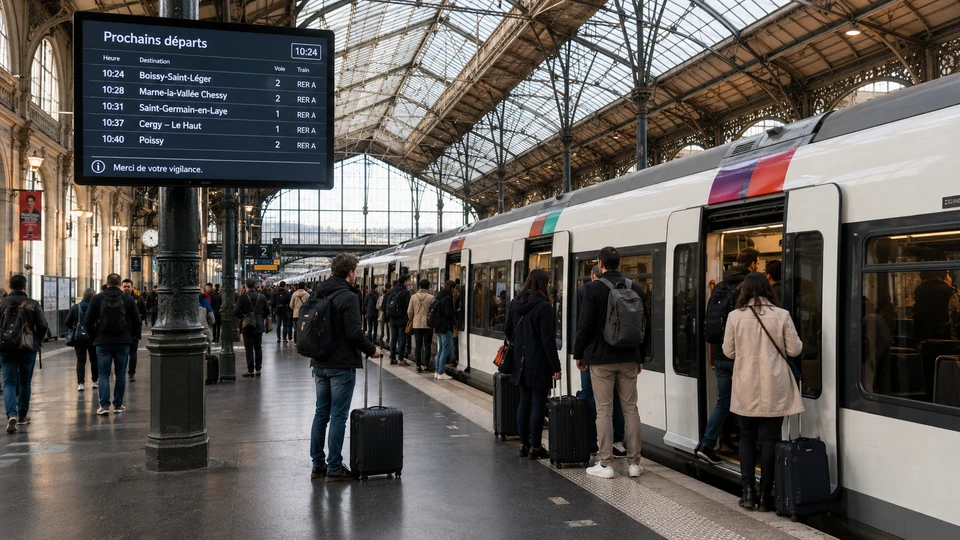
The RER B goes directly from CDG Terminal 1 or Terminal 2 (there is a shuttle service to Terminal 3) to Châtelet–Les Halles, one of the most busy interchange stations in Paris. At that point, you can either walk level ground along the edge of the Marais or take a short transfer to Line 1. Trains come about every 10 to 15 minutes and the journey takes approximately 30 to 35 minutes before you add on the walk or the change of train.
The problem is that the RER B is well known for carrying out engineering work on weekends and for having occasional delays, so reliability is relative. Taking the stairs at Châtelet with a large suitcase is unpleasant, and there is no guarantee of a seat during peak hours.
Pros:
- By far the cheapest way in
- Frequent departures, no booking needed
- Avoids road traffic entirely
Cons:
- No direct stop in Le Marais itself
- Frequent weekend works can add real delay
- Awkward with more than one suitcase per person
Actually, for a traveler going alone with a backpack and having no set schedule, this is entirely a suitable method.
You can check official train schedules and connections on the SNCF timetable page
Private Transfer
The only option is to go door to door, since it eliminates all the variables at once.

A private transfer involves a driver who is waiting at the terminal you have specified—the circular arrival hall of Terminal 1, Terminal 2E/2F in the case of most long-haul and Star Alliance flights, or Terminal 3 for low-cost carriers—having your name displayed on a sign and your flight already recorded. The driver will take you directly to your Le Marais address or, if the street layout doesn't allow it, to the nearest point possible, without you needing to consult a metro map.
Travel time takes 45 to 60 minutes depending on when you land. The A1 near Porte de la Chapelle can get very backed up around Stade de France match days. The Périphérique at Porte de Bagnolet is slow most weekday evenings between 5 and 7pm.
Pros:
- One fixed price for the whole vehicle, not per person
- No connections, no stairs, no walking with luggage
- Driver knows Le Marais's one-way streets and where drop-off actually works
Cons:
- Costs more than public transport
- Needs booking ahead rather than turning up and going
- Traffic still affects timing, even if someone else is doing the driving
For a family or a group of four, the per-person figure in favour of the transfer becomes very favourable very quickly — more on that below.
Metered Taxi
It is straightforward and cheaper than you might expect.

In Paris, an official system charges a fixed rate for airport taxis: the fare from CDG to the Right Bank—encompassing Le Marais—is set and does not depend on traffic or the route taken, eliminating the worry of seeing the meter rise on the A1. The taxis are parked outside the arrival halls at each terminal, and on a typical weekday you should not have to wait more than 10 to 15 minutes.
Pros:
- Flat Right Bank fare means no surprises
- No pre-booking required
- Widely available at all three terminals
Cons:
- Queues can stretch at peak arrival banks, especially early evening
- Drivers aren't always familiar with the Marais's tightest streets
- Card payment isn't universally smooth, so carry some cash as backup
Ride-Hailing Apps
It seems easy at first, but things get harder when you arrive.

Uber and the like are available at CDG, but the pickup points are usually a short walk from the arrival halls and price surges sharply during the peak arrival periods – exactly when you'll most want to use them. It can be effective outside of busy hours, but during the evening rush it frequently costs more than a fixed-fare taxi, when the wait is less predictable.
Pros:
- Familiar app interface, upfront estimated price
- Can be cheaper than a taxi off-peak
Cons:
- Surge pricing during busy arrival windows
- Designated pickup zones can mean a 5–10 minute walk with bags
- No guarantee of a driver who knows Le Marais's tighter corners
Shared Shuttle
The option available to travelers who have flexible schedules.
The shuttle service brings together a number of passengers who are travelling in a general direction, which reduces the cost but means that it makes several stops before you get to your destination. In the case of Le Marais, you won't usually be taken directly to your door—most shuttle companies arrange a central meeting point and then leave the final leg of the journey to you.
Pros:
- Cheaper than a private transfer
- Some flight tracking included
Cons:
- Multiple stops before yours, adding real time
- Rarely drops directly in Le Marais's narrow streets
- Fixed pickup windows, less flexibility than a taxi
Side-by-Side Comparison
| Option | Door-to-door time | Price level | Luggage | Transfers needed | Best for |
|---|---|---|---|---|---|
| RER B + walk/metro | 60–75 min | € | Tight with more than 1 bag | 1 (RER to walk/metro) | Solo, light packers |
| Private transfer | 45–60 min | €€ | Generous | 0 | Families, groups, first-timers |
| Metered taxi | 45–60 min | €€ | Good | 0 | Anyone wanting simplicity |
| Ride-hailing | 45–65 min (varies) | €–€€€ | Good | 0 | Off-peak, solo/couples |
| Shared shuttle | 75–90 min | € | Moderate | 0–1 (plus stops) | Budget travelers, flexible timing |
Which of the options is right for you?
For families who have young children – if you book a private transfer with a child seat that has been pre-arranged then you won't have to struggle with bringing the stroller down the RER stairs at Châtelet. It's worth the extra euro.
For a trip around the city — taking a taxi or booking a private transfer will enable you to quickly get into the café atmosphere of the Marais, without the metro map interfering with your jet lag.
For groups of four or more people the private transfer is usually the more economical choice, not just the more comfortable one, because the fee is charged per vehicle rather than per person.
The RER B is actually quite good for people on a budget. If you just have a light suitcase and aren't too concerned about your schedule, you'll save the most money of all the options.
If you have a lot of luggage, then don't even consider using the RER stairs. You should opt for a taxi or private transfer once you are carrying more than one bag each.
For those visiting Paris for the first time, a driver who knows in advance which street in the Marais to approach eliminates one source of stress on the first day.
For arrivals after late night or early in the morning — since the RER B doesn't operate all night, hiring a taxi or arranging a transfer in advance is actually the only sensible option outside of daytime hours.
The Case for Booking a Private Transfer with Top Paris Transfer
Work out the costs for a family of four: either four separate RER tickets or one vehicle that can accommodate everyone and all their luggage. On this route, the private transfer tends to be cheaper per person than four single train fares — and that's not even taking into account the stairs at Châtelet.
Since your driver monitors your flight, you won't have to wait anxiously or risk missing your driver even if your landing at Terminal 2E is delayed—they'll be there when you actually turn up, not when the timetable indicated you would. The price is set and given to you at the start, something that's particularly important on a route where ride-hailing apps are known to increase their fares sharply during busy arrival periods. The service also includes child seats, ample space for luggage, and is available around the clock.
A situation that is frequently mentioned is this: a family flying in from London by an evening flight that arrives late at Terminal 1, with two children and three suitcases, coming in well after the RER's normal operating hours. Since they had booked a transfer in advance, a driver was waiting for them at arrival with a car seat already installed and they were taken directly to their Marais apartment near Place des Vosges — there was no need for them to decide about taking the metro at 10 p.m. with two overtired children.
👉 Book a private transfer from Charles de Gaulle to Le Marais with Top Paris Transfer — at a fixed price and with the driver waiting for you at the arrivals.
When to Travel: Traffic & Timing on This Route
From seven to nine thirty in the morning the southbound traffic on the A1 into Paris is heavy and you should allow fifteen to twenty minutes more than your usual off-peak time.
From midday until 4 p.m. this section is usually the most smoothly travelled since the traffic on both the A1 and the Périphérique decreases considerably.
In the evening (5–7 p.m.): It is by far the worst time. Both the Porte de Bagnolet and the Porte de la Chapelle experience queues as the city empties for the evening.
After 10 p.m. it is necessary to drive quickly, but the RER B line stops running, which is why a taxi or a pre-booked transfer is the only sensible choice.
A noteworthy seasonal feature is that in the historic Jewish area of Le Marais surrounding Rue des Rosiers, shops close on Saturdays for Shabbat but remain open on Sundays—this is unlike most of Paris, where it is usual to have Sunday closures. Should your transfer arrive on a Sunday afternoon, you can expect the streets near Rue des Rosiers to be truly busy, a situation which may cause the last part of your drop-off to take longer.
What This Route Really Costs (Including the Costs Nobody Mentions)
Taking public transport is the cheapest option, but the fares are charged on a per-person basis, so for a group of four the total cost rises quickly, even if you don't take into account the physical difficulty of navigating the stairs and changing trains. A metered taxi costs €€, with the price based on the vehicle and a fixed rate for the Right Bank, which removes any anxiety about the meter. A private transfer also costs €€, charged per vehicle, but it includes a fixed booking fee, flight tracking, and guaranteed comfort. As for ride-hailing, the price can vary from € to €€€ depending entirely on the time of landing.
There are some costs that are worth being aware of: the price for the RER B does not cover the walk or the metro connection to Le Marais, so it's necessary to allow a bit more time rather than extra money. During the evening arrival peak periods, ride-hailing services can cause a seemingly inexpensive option to end up costing more than a taxi fare. Also, late-night arrivals by any means of transport outside of the taxi or private transfer flat-rate system may be subject to night surcharges, whereas a fixed-price transfer simply does not incur such charges.
When you take into account the per-person train fares, the physical difficulty of making connections with luggage, and the advantage of not having to worry about any of these things after a long flight, the private transfer is usually the cheaper option for an average family of four.
Mistakes to Avoid on the Charles de Gaulle → Le Marais Journey
If there is a direct train — there isn't, since the RER B only gets you nearly there and not all the way, and if you plan on taking a direct route your timetable will be thrown off.
To book a shared shuttle when time is short, remember that several stops before yours may add between 20 and 30 minutes that you haven't allowed for.
Not knowing which terminal you are at. The three terminals at CDG are separated from one another, so if you are at the wrong taxi rank or pickup point, you will have to walk a long distance or miss your connection.
It is necessary to check in advance if you have a lot of luggage and are travelling on the RER at the weekend, since engineering closures on this line are frequent and so it's worthwhile to take a quick look before you use it.
Because we are landing late at night and assuming that the metro will still be operating, it won't — so if your flight lands after 10 p.m. arrange a taxi or book a transfer in advance.
Failure to take into account the evening rush hour traffic on the A1 means that a landing at 5 p.m. will result in a considerably longer drive than the same journey at midday.
FAQ
Is there a direct train available from CDG to Le Marais?
By no means does the RER B serve Châtelet–Les Halles, it being about a 10 to 15 minute walk or one metro stop from the edge of Le Marais — it's near, but there is no direct link.
How long does the journey take from CDG to Le Marais?
It takes about 45 to 75 minutes depending on the mode of transport and the time of day, private transfers and taxis usually being faster than the RER when you take into account the walking time or the need to change trains.
What is the fare for a taxi from CDG to Le Marais?
On the Right Bank of Paris, which includes the district of Le Marais, there is an official system that charges a flat rate, the amount remaining the same no matter what the level of traffic and the price being charged per vehicle rather than per person.
Is it possible for a taxi or private transfer to take me directly to my address in Le Marais?
Typically as close as the street configuration permits, since a number of the streets adjacent to Rue des Rosiers and Rue Vieille du Temple are narrow and one-way, drivers who are familiar with the area will know the closest possible drop-off point.
Is the RER B a good choice if you have children or a lot of luggage?
It's manageable with one bag each and no small children, but the stairs at Châtelet and the lack of a direct stop make it a harder sell for families.
Does traffic get worse around Stade de France?
Yes — the A1 passes right by it, and match or event days can add significant delay to journeys at that time.
Is it worth pre-booking a transfer instead of taking a taxi on arrival?
For predictable pricing and a driver already tracking your flight, yes — especially for late-night arrivals or when the taxi queue at your terminal is running long.
What's the cheapest way to get from CDG to Le Marais?
The RER B combined with a short walk or one metro stop is the cheapest option by a clear margin, provided you're traveling light.
Other Popular Blog You Might Need
- Best Ways to Get From Charles de Gaulle to Hotel Cheyenne: Every Transfer Option Compared (2026 Guide)
- Best Ways to Get from Charles de Gaulle to Newport Bay Club: Every Transfer Option Compared (2026 Guide)
- CDG to Hotel l'Elysée Val d'Europe: Every Transfer Option Compared (2026 Guide)
- Charles de Gaulle to Radisson Blu Hotel Paris Marne-la-Vallée: Every Transfer Option Compared (2026 Guide)